Thursday, January 04, 2007

San Biagio – Holiday Tradition in Milan – Panettone and more Panettone

Strolling along the streets of Milan, during the early days of February, Panettone, the Christmas bread of Milan, is sold with steep discounts. While not all stores will offer such heavy discounts the tradition is “two Panettone for the price of one.” Many think that this is an end of season sale to eliminate the remaining inventory of Panettone, instead nothing could be farther from the truth. This tradition is deeply routed in Milan’s culture. The 3rd of February is day where all Milanesi eat Panettone. This is the day of San Biagio.

San Biagio was born in Armenia at the end of the III century AD. He was a prominent doctor and the people of Armenia wanted him to become Bishop. He did not want to accept the position. He felt he was not worthy. He did finally accept however he continued to practice his profession of physician.

During a religious function a woman approached him carrying her son who was choking. The child had swallowed a fishbone and it was stuck in his throat. The Bishop threw aside his religious duties, realized the boy’s difficulty and shoved a piece of consecrated bread in the boy’s mouth and made him swallow. The bread carried the fishbone into the boy’s stomach allowing the child to breathe. The congregation cried miracle. The Bishop attempted to keep a low profile but word of his miracles reached the governor of the Roman province who did not like the public appeal of this upstart religious man.

Agricola, the Pretore, was convinced that the best solution was to kill San Biagio and that his following would soon disband. Agricola summoned San Biagio to his court. San Biagio was skinned alive with iron combs and then decapitated in a show of power of the Roman Empire. The error was fatal to the Pretore’s political career. San Biagio first became a Martyr and later Saint. San Biagio is the Protector Saint of the Throat.

The question remains what does this have to do with the Milan. San Biagio never visited Milan. We must advance several centuries. The Catholic church is now the official religion of the state. Panettone is prepared for the Christmas holidays and as all things related to the religious culture a matriarch took her Panettone to the local priest, Desiderio, to be blessed. Desiderio was very busy for the holidays and suggested that the lady leave the Panettone and he would bless it as soon as he could. She could then visit and take the Panettone home. The woman forgot her Panettone and the days passed but the priest had not forgotten the delicious sweet bread.

Every day he would walk by the Panettone and break off a small piece to eat. The days passed and the Panettone became smaller and smaller until it was completed consumed. The matriarch finally remembered her Panettone and went to visit Desiderio on the third of February. Slowly the priest went the corner where the Panettone should have laid inside its shiny wrapping. Much to his surprise the wrapper was filled with a Panettone twice the size of the original. Out of relief he cried, “Miracolo, deve essere stato San Biagio!”

The woman convinced that he spoke of the increased size of the Panettone told her neighbors and the following year many more Panettone arrived to be blessed. Desiderio explained that miracles are not so easily achieved but that each family should keep the blessed Panettone at least through the third of February. The Panettone should be consumed instead of blessed bread and that San Biagio would protect them. Since San Biagio is the Saint Protector of the throat today, it is believed by old and young alike, that eating Panettone on the 3rd of February will protect them from illness in the cold hinterland winter. The two for one sale is because of the Miracle of the Growing Panettone!

If Panettone goes on sale at your local store, buy one and set it aside for the 3rd of February. It may not be as effective as the flu shot but it surely is more tasty!

Tags:


Labels: , , , ,

Read the Full Story...

Monday, January 01, 2007

The Epiphany and the Good Witch

The Befana, an ugly old witch with tattered clothes, broken shoes and a heart of gold, brings sweets to the nice and coal to the naughty. Riding on her broom she brings gifts and takes away the holiday season, “L’Epifania tutte le feste, porta via!” On the night between the 5th and 6th of January the Befana arrives, consumes the cookies and milk and leaves gifts for all who believe. This antique tradition celebrates the pilgrimage of the Wise Men to Baby Jesus. There are numerous stories, poems and rhymes telling the story of the good witch who brings gifts. The best known rhyme describes the Befana,


La Befana vien di notte
con le scarpe tutte rotte
col cappello alla romana
viva viva la Befana!

The Befana comes by night
With her shoes broken and tight
With her hat in style Romana
Hurray, Hurray, the Befana

The probable origin of the Befana dates back into the XII century. Each small town, province and region spoke different dialects, languages in their own right. Epiphany, in the various dialects, was pronounced: in Tuscan, “Befania”, in Roman, “Pasqua Befania”, in Pugliese, “Pasqua Befani’” and the Calabresi, “Bufania”. During the period of remembrance of the trip of the Wise Men, the poor of the town would travel from house to house. Those who had something to give would leave various foodstuffs that the poor would gather before the long period of cold where food was difficult to find. It was thought the helping the poor would be compensated by a fruitful growing season and prosperity would come to the family if it shared in its wealth.

Since the gift was to be anonymous, in order not to shame the poor, the children were sent to bed with the promise of treats after the Befana came. The poor were often very poor, with broken shoes and tattered clothes on their backs. The Befana took their image and stories were created telling of how the Befana had been an evil witch who converted to good.

Around the XV century local holidays further augmented the tradition of the Befana. Towns prepared a week of celebrations and parades where on the 6th of January would be burned in effigy. The concept was that by giving freely to those less fortunate the family would honor the Christian spirit. The great celebration of burning the Befana was a symbol representing the elimination of poverty.

The Befana travels from house to house on her broomstick. Over her shoulder is draped a burlap sack filled with dried fruit, oranges, gifts and a good portion of ash and coal. In the fall children begin preparing their letters to the Befana, listing their good deeds and the things they desire. Good children receive the treats and naughty children the coal. Each child would leave his sock hanging from the mantle and would receive his merited reward.

As migration brought different cultures together, traditions were shared and adopted. Saint Nicholas and the Befana had similar roles and the traditions merged. Even in Italy the Befana has been losing ground over the last fifty years as the religious influence on modern culture decreases. The Befana today is making a comeback as many Italians are looking back to their traditions to maintain their identity as the world is subjected to globalization.

Urbania, in the Marche, has an annual festival of the Befana with 10 days of shows, fairs, parades and feasts. There are also numerous other cities, across the entire peninsula, where the antique tradition can be experienced with a child’s excitement of a magical holiday.


Tags:

Labels: , , , , ,

Read the Full Story...

Monday, December 25, 2006

Christmas Prayer 2006 – I am blessed

The way is perilous on the never ending ascent. The sparkling glitter of trinkets around every corner distract the pilgrim, the peak is always just across the next knoll, in sight but still a lifetime away. Darkness falls and fades away as day turns to night and night to day. Another step, another minute, another opportunity, another challenge.

A windmill appears and a blow is thrown, in symphony the sail sweeps across and knocks the nobleman from his steed. Just as quickly as it appears, it is gone, no longer a threat, nor a challenge, as if it never existed.


The parlors are bright, beautiful sumptuous cloths caress the beautiful people as the sit and chat smug in their existence. Colored lights adorn the entrance, the windows; the outline of the papier-mâché cottage is so beautiful, so perfect. Yet the night air chills to the bone and the pilgrim pulls his vestige closer. The winter snows are at hand; press on good sir. An invitation is offered, “stay with us, the night is dark and the wind cold”.

The pilgrim continues. He has his path, his reason to exist, his passion. The journey continues, he has his mission and has received all the purpose necessary to complete his quest without distraction. The heart burns; sometimes it seems it will burst, pumping so hard the veins along his neck expand and pulsate. There is no distraction, no time to warm the aging body, or rest the tired soul. The passion drives him and somehow is in need of protection. It is an oxymoron of infinite proportions, so powerful yet so meek.

The summit will never be obtained, it will always be just out of reach, just a few steps more, but the pilgrim does not care. It is not the capturing or dominating the path that counts but the journey, accompanying his passion. Experiencing fulfillment in the midst of failure and humility in the rewards of success. That which is important is clear. It is simply the jewel that shines for eternity. It cannot be bought, borrowed or stolen. It must be given as a precious present and received with fullness of heart, mind and soul.

My Christmas prayer this year: Thank you for my Raffaella.


Labels: ,

Read the Full Story...

Thursday, December 14, 2006

Caffe Valdostana – Coffee from Valle d’Aosta and the Friendship Cup

Christmas Traditions and Winter Holidays sometimes become confused. The Coppa dell’Amicizia, Friendship Cup, is an antique after dinner tradition of this region hidden in the Italian Alps. Traditionally Caffe Valdostana is served only in the winter months.

The birth of this specialty is accredited to the "Marroniers" or "Soldats de la neige" of Saint Rhemy En Bosses who patrolled the mountains of the Gran San Bernardo from 1100 through 1930. These mountain soldiers acted as guides and offered refuge to travelers. Caffe Valdostana became a tradition because not just the soldiers needed extra energy to fight the cold and hostile environment. This coffee was the favorite of lumberjacks, miners, bricklayers and farmers who would prepare a pot of Caffe Valdostana, or simply with grappa, for a nice pick me up during the cold winter days.

There were numerous other coffee drinks around at the time but Caffe Valdostana was the favorite. Passed down from generation to generation each family developed their own special recipe. Other than the basic ingredients listed here there are numerous other things that can be added to the basic recipe. Cognac, Rhum, Genepy, Plum Grappa, Butter and Orange peel are some of the ways to personalize your caffe Valdostana.

This hot coffee drink has its own way to be served. The Friendship cup is a hand carved wooden cup. The cup has numerous spouts. The Caffe Valdostana is prepared, poured into the Friendship cup and the cover placed on. The cup is then passed around and each member of the group drinks from a different spout. The Coppa Amicizia, Friendship cup, is a novelty for Italians across the peninsula. The workmanship is unique and the cups are purchased as collector's items or as decorative objects to be shown off with pride.

The tradition requires that the each individual of the group must continue to drink a small amount of coffee from the Coppa Amicizia. The cup is then passed to the next individual in turn. This continues until all the coffee is consumed. While there is Caffe Valdostana the cup must never be put down. There is also a saying, “He who drinks Caffe Valdostana alone, will choke.”

Ingredients:

2 cups long coffee. I make a “6 cup Moka” and add boiling water to make up the difference.
¾ cups strong Grapa, at least 45% per volume, preferably from Valle d’Aosta
¼ cups Genepy or Cointreau (some areas use red wine)
2 tbsp sugar
Orange Peel

Preparation:

Place all the ingredients in a medium saucepan over medium heat. Bring to a boil. Pour into the Coppa Amicizia.


Wet the rim of the spouts with Grappa. Crust the rim of the spouts with sugar. I use a teaspoon with sugar and quickly press it on the rim. Light the Caffe Valdostana. Allow the alcohol to burn until the sugar caramelizes. Cover the opening with its top and drink hardy!


Tags:

Labels: , , , , , , ,

Read the Full Story...

Thursday, November 30, 2006

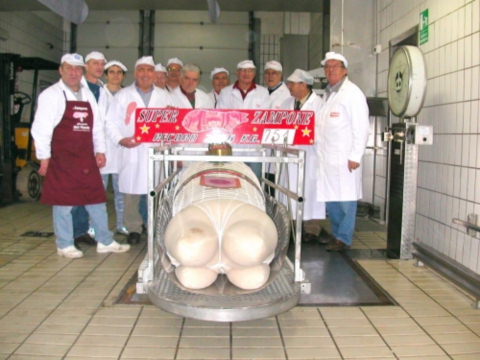
New Record Super Zampone 751 kg

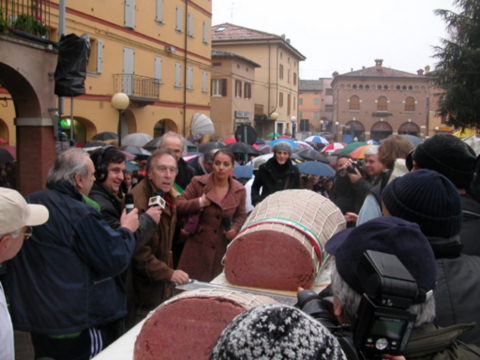
You know Italians are serious about pork and dried meats when the best butchers get together every year to make the largest Zampone in the world. Since 1989 the city of Castelnuovo di Rangone, in the province of Modena, has hosted the Annual FESTA DELLO ZAMPONE PIU' GRANDE DEL MONDO. This year’s masterpiece is 751 kg. I know that many Americans grimace at the thought of Zampone. Last year I wrote about one the most widely used dishes on New Years Day, Lentils and Zampone. By the comments it was clear that most thought, “ughhh, that’s gross!”
This reaction is a result of our industrially processed and packaged culture. Who among us does not love Balogna? Sometimes Bologna is known as Baloney, or the Italian immigrant’s spelling of Bologna, the dried meat most widely used in the city. Bologna and Modena, two sister cities just a few kilometers apart in Emilia Romagna, make Mortadella. Baloney is actually the Italian immigrant’s version of Mortadella. Now here is the trick. Zampone is very similar to Mortadella. Both are various cuts of pork, mixed with various spices or herbs, and allowed to cure. Zampone is a celebration of the best cuts of pork. It is reserved for the highest of holidays. It is a specialty, something to prepare on a rare occasion.

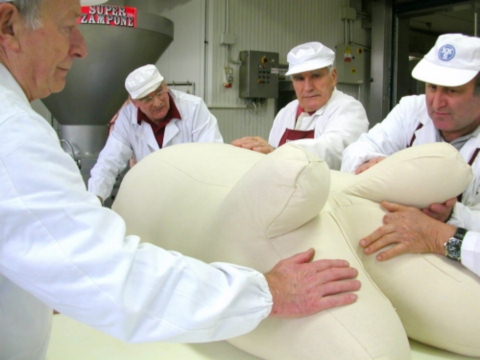
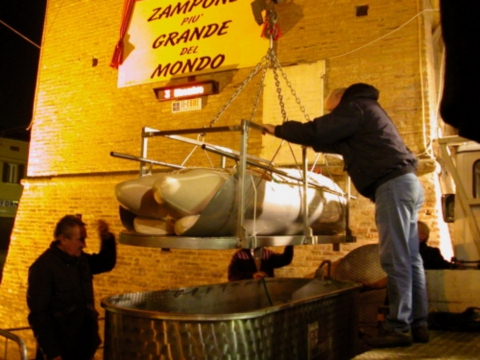
Every year on the first Sunday of December the Master Butchers of Castelnuovo offer Zampone to all who wish to participate. The one objective is to make a Zampone bigger than the previous year’s production. In 2005 they failed miserably coming up almost 100 kg light but this year’s Zampone beat all records. The Zampone is made of linen. It is then filled with the top cuts of pork with as many as 20 butcher’s working at the same time. The Zampone is completely on the 30th of November and then cooks for 60 hours in a special stainless steel pot. Sunday morning, at 11:00 the cooked Zampone is then offered, along with accompanying Lambrusco and Parmesan cheese, to thousands of visitors. The actual data is impressive:

Weight: 751 kg (1,652 lbs)
Length: 3.10 meters (Just over 10 ft.)
Diameter: 1.4 meters
Total cooking time: 74 hours
People served: 6,000
Consumed in: 1 hour!

This is a party! It is fun and if you have the opportunity to be in the area of Bologna for the first Sunday in December this is a must see!

Tags:

Labels: , , , ,

Read the Full Story...

Wednesday, November 29, 2006

Asiago – Not just Cheese!

Italian Christmas traditions vary from region to region just as their culture, food and wine. Asiago is best known outside of Italy for the flavorful cheese that carries its name. Asiago is located on the high plains in the Province of Vicenza between the rivers Brenta and Astico. At an altitude of 1000 meters above sea level the plain precipitate on the Northern and Eastern borders into the Valley Valsugana.

The high Plains of Asiago are formed like a shell. The seven towns of Roana, Rotzo, Lusiana, Conco, Gallio, Foza and Enego are protected from the winter winds by the mountain range that reaches heights of 2,341 meters. The sun shines brightly on the snow covered lands for 8-9 hours a day during the winter months. It is the image of every winter snow crystal. Tranquility abounds as the snow sparkles in the day’s light.

The history of Asiago is closely tied to wars and the defense of the Italian Penisula. Castles from centuries past and fortifications of wars as recent as WWII are open to visitors. The city is also home to the astrological observatory built in 1942 to celebrate the passing of Galileo, 300 years earlier. The night is so clear that two major telescopes were added in 1956 and 1965. The final and most impressive telescope, with a diameter of 182 cm., was added in 1973.

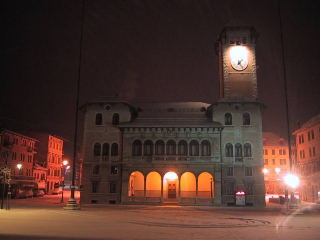
Asiago is Christmas from November through February. Evergreens covered in snow. Mountain homes with ice crystals lazily draped down across the windows and doors. Asiago has added a new activity to their Christmas winter attractions. Starting the 3rd of December, Asiago offers Christmas encounters and fairs. Christmas lights and trekking in the heavy snow are weekend activities.

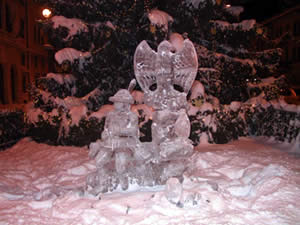
The International Ice Sculpture tournament has found a home from December 16 through January 15. The entire city will be turned into a show as artists create their visions in the squares and along the boulevards of the city’s center.

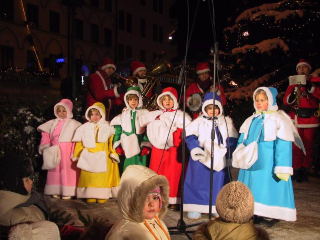
Christmas Eve is celebrated in the Duomo at 11 pm as the city’s inhabitants await the festivities of the birth of Christ. Babbo Natale (Santa Claus) and the Chorus of Asiago are the attractions of Christmas day. The final procession of Father Christmas is an evening stroll with candles through the city’s antique center on December 27.

Asiago is not the first place one thinks of when traveling to Italy. Most likely it does not come to mind however Christmas in Asiago is truly Christmas.

Tags:

Labels: , , , ,

Read the Full Story...

Sunday, November 19, 2006

Italian Christmas Traditions – Christmas in Merano – Dream Destination

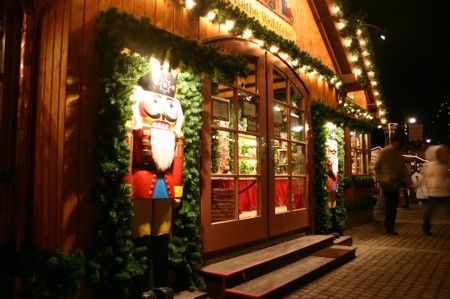
A fairytale scene, the streets are white with snow. The Dolomite Mountains tower high into the evening sky. Cedar shingled shops with high pointed roofs line the path that disappears into a goose down comforter. We try to catch on our tongue the quarter size crystals falling from the sky, scuffling our boots in the newly fallen snow. White lights twinkle above our heads, reflecting, blinking. It becomes difficult to tell the difference between the snow falling and the Christmas lights forming patterns of stars, snowflakes and Santa Claus. It is somehow dark of night and bright as midday at the same time.

The shops shine from their windows colors of red and gold. Evergreen branches adorn the doors and windows. A wood carved totem of Santa Claus here and the Toy Soldier of the Nutcracker Suite there. People scurry, packages with brightly colored paper and hand tied silk bows in their hands. Music plays in the background muffled by the snow and the perfume of sweet holiday bread fills overwhelms. My nose is cold, Raffaella’s cheeks are bright red yet we continue down the street humming sometimes outright singing the Christmas songs. No one seems to mind or for that matter notice. The air is festive.

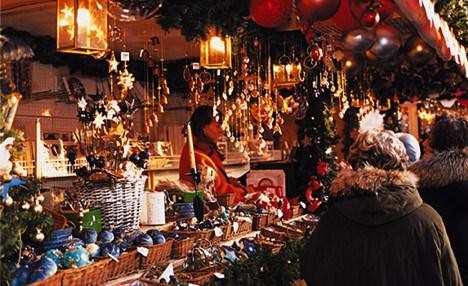
Every few steps, we stop, and gaze at the marvels displayed in the windows. Just ahead the Christmas Fair, sixty or so artisan stands of fresh bread, dried meats and cheeses. The brass band plays, accompanied by the local choir, songs of Christmas and the church bells chime, some on the hour, others on the half. If Christmas had a smell, this would be it. The scent of pine on the wind, the fresh smell of snow renewing continuously, fresh bread baking, Vin Brule’ in a cup, and hand carved candles burning. Look across the street, it is the post office of Santa Claus.

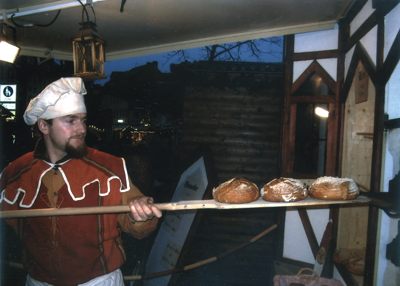
Every year the city of Merano in South Tyrol hosts a Christmas Fair during the entire month of December. Local artisans sell their handmade Christmas candles and woodcarvings. The local meats and cheeses are some of the main attractions. Bakers move their wood burning ovens into the streets and fill the air with a constant and pervasive perfume of fresh baked breads. The Christmas fair in Merano is not your typical Italian destination. It is the mountainous Italy where the local dialect is more Austrian than Italian but this is Italy. It is tradition. It is an important part of the rich cultures accumulated over the centuries, mixing and blending. It is Christmas.

Take your heavy coat and a good appetite. Plan a week, perhaps with some cross country skiing or hiking. Bring your love for wine, this is home to the International Wine Festival. Bring your loved one and most of all, bring your inner child, that part of you that wants to skip down the street, make snow angels, sing Christmas carols, eat until you cannot move any more and revel in the fascination of Christmas.

Tags:


Labels: , , ,

Read the Full Story...

Friday, November 17, 2006

Zampognari – Italian Christmas Bagpipes

Bagpipes are from Scotland, aren’t they?

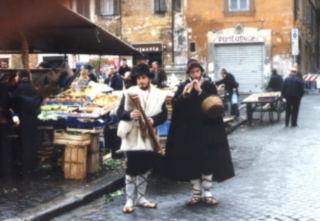
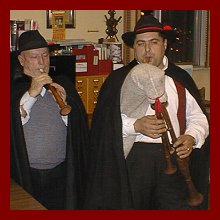
We think of accordions, strolling minstrels playing their folkloristic melodies, all year round in traditional garb, but bagpipes are not one of the images that come to mind when thinking about Italian Christmas traditions. I was surprised to hear, early in the morning on a cold December day, bagpipes whining. Joyful tunes, playful melodies entered the courtyard just outside our home. Robust gentlemen, dressed in knickers and heavy wool capes, played their instruments. Shortly the courtyard was full of life as children appeared, pulling on their sweaters, as they exited their home. Windows popped open from the upper floors as the figures of the stoic Matriarchs watched attentively. The glimpse of a smile on their lips, they hummed songs of times past.

It was the Immacolata, the day celebrating Maria, the soon to be mother of Christ. The songs praise the Madonna and announce the joyous events to come. The tradition is not Milanese, although the Zampognari are part of Christmas traditions throughout Italy. The origins seem to be both Sicilian and Roman. The stories differ in the individuals involved but the essence is the same. The shepherds play the bagpipes, as in Scotland the sheepherders made instruments from the materials available, so did the shepherds of Italy. Their lives spent long away from civilization, searching for green fields for their herds, rarely would they come to town. Christmas is a special occasion. A period where all return to their families and the shepherds would descend from the surrounding hills and pastures with their herds, playing their instruments, announcing their arrival for the holidays.

Shepherd pipers are originally from the mountain villages around Rome and from the Abruzzi region. Dressed in crisscrossed leather leggings, short bulky trousers that are buckled just below the knee, vests of sheepskin (unfortunately now often replaced by more “fashionable” synthetics), velvet jackets and peaked caps, these pipers are a contemporary link to the original shepherds that visited the child in the manger in Bethlehem.


The music is joyful. It is a time of reunion and of company. It means that Christmas will soon arrive. In northern Italy this tradition is primarily in the smaller towns, rarely seen in Milan. In Rome and most parts of Sicily, beginning with the 8th of December, the shepherds march the streets and squares, playing their bagpipes. They are prevalent and it is not unusual for crowds to gather and follow. Singing songs passed down through the generations. A type of Christmas Caroling, it signals the beginning of the holiday season.

Tags:

Labels: , ,

Read the Full Story...

Thursday, November 16, 2006

Italian Christmas Tradition – Torrone from Cremona

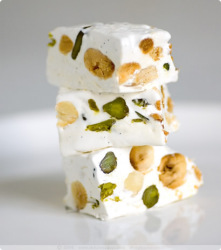
An Italian Christmas Tradition, the Turun or Torrone of Cremona, has conquered the world. Almost every Italian little town has their own recipe as does just about every Southern European town. Yes the Torrone of Cremona, now widely distributed year round in US grocery stores, is an Italian Christmas delight. The origins of Torrone are a bit more confused than the success of the natural candy bar.

The most widely accepted version tells of the master chef of Cremona created this sweet in 1441 on the 25th of October in occasion of the nuptials of Francesco Sforza and Bianca Maria Visconti. A wedding that would bring together the two most powerful families of the known world. That must have been some wedding; the dowry was the City of Cremona. Some say Torrone was created in order to use the egg whites left over after preparing thousand of pastries while others indicate that Turun and Cupedia were versions of the Arab and Roman Empires respectively. Both of these sweets would have origins several hundred years before Christ.

Since I was not around at the time, I will simply narrate what is written and what seems probable. The scribes of the Sforza family indicate that the master chef of Cremona created a compact dessert of almonds, honey and egg whites. The dessert was a sculpture of the Bell Tower of the Duomo of Cremona, said Torrazzo and in those years called Torrione, in English “Really Big Tower.”

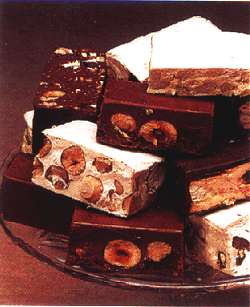
Whether Torrone was initially created during the Roman Empire or in occasion of the Sforza wedding, Torrone is synonymous with Cremona. Its production is one of Cremona’s primary industries. The natural goodness of this antique candy has taken over the world. Originally Torrone was rock hard. I mean break your teeth hard and while this original version is not as easy to find, it is the only Torrone for the truly passionate. Today you can find soft Torrone, Chewy Torrone, Torrone covered in Chocolate, Torrone with Hazelnuts or citrus and many other versions.

Until recent years Torrone was available from October through January and associated with Christmas. Today it can be found throughout the year and is a good substitution for the industrial candy bars. That is not to say that this treat does not have a lot of calories, simply that it is an antique recipe and most likely will not rot your teeth, it may break them if you are fortunate to find an original version, but it will not rot them.

The best thing about Torrone is that it is not difficult to make and can be easily adapted to just about any taste.

Ingredients:

8 oz. (250 g) Hazelnuts
10 oz. (320 g) Almonds
8 oz. (250 g) Honey
11 oz. (320 g) Sugar
3 egg whites
Grated peel of one orange
1 3/4 oz. (50 g) candied orange peel
2 tbsp Brandy
1 tsp Vanilla Extract
10 Communion wafers (or other thin wafer)

Preparation:

If the almonds still have the skin. Blanch the almonds in boiling water for 3 minutes. Drain and dry.

Heat the oven to 350 degrees. Place the almonds on a baking pan with parchment paper. Toast for 5 minutes. Rub the almonds in a towel, the skins will come off in the towel.

In a double boiler, over medium heat, pour the honey. Let the honey cook for about 1 hour. Stir occasionally with a wooden spoon.

Place the candied orange peel in a small cup. Add the Brandy and let sit while the honey cooks.

When the honey is blond in color, whip the egg whites to firm peaks. Slowly, add the egg whites to the honey, mixing from bottom to top, never side to side. The honey will swell up and foam.

In a separate pan heat the sugar. When the sugar starts to brown, add the sugar to the honey-egg white mixture, stirring continuously. The mixture will begin to lose volume and become thicker.

To see if the mixture is ready, drop a teaspoon of the mixture into cold water. The cold water will immediately bring it to its consistency. You can verify if it is at the hardness you desire. If you want it harder just continue cooking a bit longer.

Drain the candied orange peel. Add the remaining ingredients, except the wafers, to the mixture. Stir quickly and try to distribute the hard ingredients evenly in the paste.
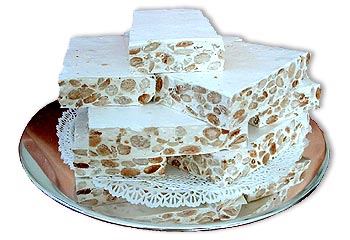
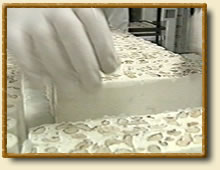
Place the 1/2 of the wafers on a hard surface, preferably marble or granite. Pour the mixture onto the wafers. Mold the now hardening mixture into a rectangle about 2 inches high. Smooth the top of the mixture and place the remaining wafers. Press gently and allow to cool completely. The Torrone can now be cut into pieces of any size.

Tags:

Labels: , , , , ,

Read the Full Story...

Tuesday, November 14, 2006

Sant’Ambrogio – La fiera dei Obej Obej – Vino Brule’

Che Bello, Che Bello, is the name of an antique tradition of Milan. Dating back to the early 1500s, Sant’Ambrogio, the Patron Saint of Milan, the Bees, Producers of Honey and Producers of Wax, has been a day festivities. The 7th of December is one of the most anticipated days of the year. The 8th is the Immacolata, a national holiday. Each city also celebrates its patron saint by closing the offices and putting on Sagre and Fairs. The Sagra of Milan is the Obej, Obej meaning how beautiful, how beautiful. The fair has been located in the square in front of the Basilica of Sant’Ambrogio for the last 400 years but this year will be moved to the square in front of Castello Sforzesco.


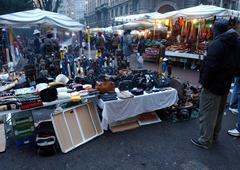
Two consecutive days of holiday, not in the month of August, are just the occasion for a great celebration. Many Milanesi will hit the Italian Alps for some skiing, others will make their way to Liguria for the milder weather, but many of Milan’s 3 million inhabitants will remain at home. It is estimated that in the 3 days of the Sagra more than 1 million people will visit the thousands of bancarelle, street tables, showing their goods. New items, old items, antique books, mirrors and paintings, there are foods of every type, designer clothes, and handwritten and illustrated books.
The Sagra dei Obej, Obej has its own song, proudly exhibited by the native Milanese during the festivities. There is a difference between those whose family hails from inside the circle of the 92 and the Provincial Milanesi. Of course there are the Brianzoli, who call themselves Milanesi but are not. It is in the dialect of Milan and often can be heard at the traditional pubs:


oohhh beej ohh bejjjj
le la fiera di quei più se bei
oohhh beej ohh
bejjjj
ghe nell'aria un profum di tortei
ghe una via piena di pittur
le una festa per i colur
per i rottamate , e per i strasce de milaannnn
de bellè ghe ne gran burdell, se ne ne incutra te spenda poc
e ghe pur
quel del sucher filattttttttt
etc etc etc …
oohhh beej ohh bejjjj

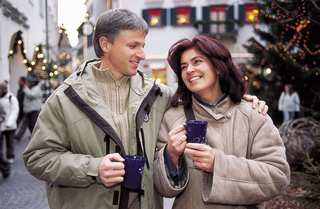
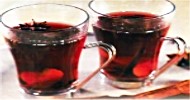
There is also vino Brule’, a welcomed drink during the cold Milan December. Vino Brule’ is an experience. The humidity is always a bit high and when the cold wind blows off the Alps just 40 km to the north, your bones chill. Vino Brule’ is the solution. It is hot, spiced red wine. If in Milan, this tradition is a must, no matter what your age.

Ingredients:

1 liter Red Wine
1/3 cup (100 g.) Sugar
3 Cloves
¼ Nutmeg
1 stick of cinnamon
Peel of 1 lemon

Preparation

In a medium pot pour the wine over medium heat. Stir in the sugar. Add the remaining ingredients. Let the mixture come to a boil. Once the sugar has completely dissolved, remove from the heat and pour the mixture through cheesecloth. Serve hot!

Tags:


Labels: , , , ,

Read the Full Story...

Saturday, November 11, 2006

Le Caldarroste – Chestnuts roasting on an Open Fire

Humming joyfully in Milan’s nippy morning air, “Chestnuts roasting on an open fire, Jack Frost nipping at my nose…”

Oops, wrong country.

Have you ever had roasted chestnuts? I had my first open fire roasted chestnuts on the streets of Milan on Saturday morning. I know, it is embarrassing. I, like most Americans grew up singing about roasted chestnuts at Christmas time. I was even born in the north and most of my youth was spent in cities that could be considered north but to my defense, I come from a Southern family. My family is so southern that when my grandmother was 7 months pregnant with my father and was living in New York, she left her husband, moved back down to South Carolina to stay with her relatives because there was no way she was going to have a “Yankee” in her family.

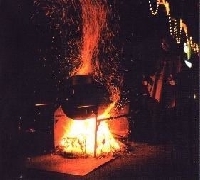
My oldest daughter was about nine months old. We were strolling piazza Duomo, enjoying the Christmas lights and Nativity Scenes, and it was cold. Even though I had several sweaters underneath my overcoat and wool scarf the chill made my bones creak. In the corner of the piazza, next the Duomo and across the street from the Rinanscente was an old man with a cart. His face was weathered and his hands rough but I could tell he was warmer than I was because his jacket was open and his scarf laid to one side on his shoulder. I noticed a wood burning fire in the lower portion of the cart with flames lapping up and around the sides of a rotating, round, iron plate.

He called into the morning air, “CALDAAAAAARROSTE!” and spun the disk causing these little nuggets on the plate to shift and resettle.

The air filled with a sweet perfume and again a call, “Marroni Caldi!” and again a pull on the plate, the fire crackled a bit and there was that perfume. It was sweet like baked nuts and honey.

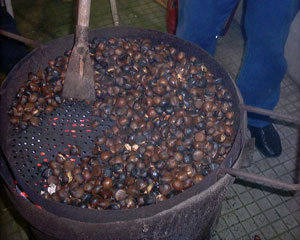
My mouth was watering even though I had no clue as to what he was roasting and the cold in my back pushed toward the street vendor. As I came closer and could see the contents of the plate it was clear they were some type of nuts. The shell was burned black and had been split on one side. The meat of the nut exposed to the plate looked crisp and slightly burned. I had learned over the past few years that my culinary preparation was lacking and that it was generally a good idea to try just about anything sold by the street vendors. I was further encouraged as I saw the little kids pulling on their parents coats begging for the Caldarroste.

The handwritten sign above the cart indicated “five mil” (five thousand lira) for a bag of these roasted nuts. Although I was poor I could afford “five mil”, so I made my purchase. Perhaps he realized my inexperience and pushed about 10 napkins into my bag before I stepped aside. I reached into the bag and grasped one of the caldarroste. Quickly my hand retreated; they were hot, oh so hot, as if they had been roasted over an open fire!?!

Now prepared for the burning sensation, I learn quickly, gingerly I broke open one of the nuts to reveal a soft, steaming hot meat. I broke half of the nut off with my teeth, yes still hot, and my mouth was filled with a honey sweet taste. The slightly charred part of the nut was a bit hard creating a contrast of soft and crunchy. It was very satisfying. Needless to say, the bag of roasted nuts did not last long. As I was about throw away the bag, I thought, but the napkins? A quick look at my hands revealed the answer. They were coal black. Roasted chestnuts create a tremendous amount of soot. Perhaps, this is also the reason of the permeating perfume they release while cooking. The ten napkins were barely enough to clean my hands.

Upon my return home, I pulled out my Italian/English dictionary and found Caldarroste. Chestnuts, I thought, where do I know chestnuts from? It was several days later that I associated chestnuts to the Christmas carols I had sung since a small child. Again, chestnuts are not just Italian, but with something so good, how is it possible that I had never had them before. To this day I cannot answer that last question but next time in Italy over the Christmas holidays, buy some CALDAAAARROSTE and you may decide that this is one lost Christmas tradition well worth a rebirth.

Tags:

Labels: , , , ,

Read the Full Story...