Friday, December 01, 2006

Artegna, Friuli, Venezia, Giulia – Re Purcit in Staiare – Celebration of the Pig

Purcit, in the dialect of Friuli, means pig. Staiare is the ancient Friulano dance, a variation of the Stiria Asburgica, of celebration. The dance was an integral part of the town’s local festivities. Purcit in Staiare is similar to the Thanksgiving holiday in the US. It is a time of thanks when the family’s pigs were slaughtered guaranteeing a nutrient source of meat for the upcoming winter. The pigs were a family’s greatest value.
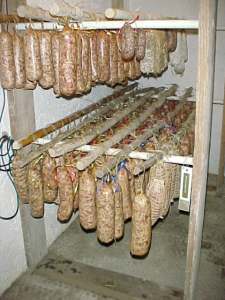
The day of Saint Andrea, in the early morning light, the atmosphere was solemn when the butcher, both respected and feared, would arrive in the family’s home. As the day progressed and the salami, prosciutto, sausages, culatello, pancetta and zampone were prepared, the air would become more joyous and festive. The job was intense involving all members of the family, from the youngest to the most elder as the cellars filled with the meats hung to dry.

Times have changed. Life in Friuli is no longer tied to the seasons. The Purcit in Staiare is a way for the people to remember times past, to connect with their traditions, their ancestors and the things that make them who they are.
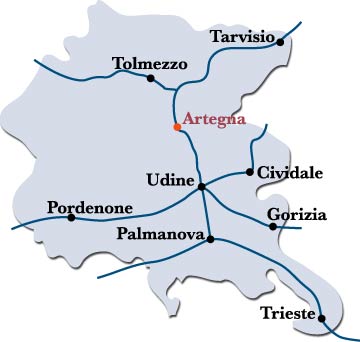
Every year, the last week in November, 20,000 people of the towns of Friuli and the mountain communities surrounding the area celebrate these traditions in Artegna. During the festivities the fattest pig is crowned king for the day. Although this may seem strange the tale of the King of Artegna explains the mystery.

A long time ago there was a kingdom, rich and opulent. All the kingdom’s subjects had enough food to eat and peace reigned throughout the land. In the capital of the kingdom, Artegna, the just and righteous king, Purcit, lived and ruled in the castle of Cjot.
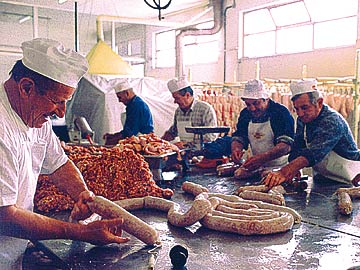
Each day, after a healthy meal, he would sneak into the hidden dungeons of the castle where a magic talking scale was kept. He would step onto the scale and ask,

“Magic Scale, loyal subject of my realm, who is the fattest of the kingdom?”

Like clockwork, the magic scale would respond,

“There is no doubt my lord, there are none fatter than you!”

Content the king would return to his daily business. For many years the scene was repeated until one day, to the surprise of the king, the scale said,

“Fat you are my lord, but you must know, that fatter than you, one does exist.”

The king was furious. In rage he jumped up and down on the magic scale until it was broken into little pieces. The king became obsessed by his vanity and would eat and sleep forgetting his responsibilities. He became an evil ruler, taxing his people to near starvation to feed his desire.

Finally the day arrived. The king was sure that he no one could be fatter than he. He ordered all of his subjects summoned for a banquet to celebrate his opulence. On the day of his celebration the banquet halls were filled with every sort of food and his subjects, starved and broken, were around the hall to watch the king enjoy his feast. The king ate and ate. A voice arose from the crowd, desperate with hunger,

“To the table!”

The entire kingdom swarmed over the banquet and the king crushing him. The king was then carved and served to the people by the royal butchers and it is said there was sufficient meat to feed the entire kingdom for a year.

To this day the king of the day is the fattest pig in the kingdom, Il Re Purcit!

Tags:

Labels: , , , ,

Read the Full Story...

Thursday, November 30, 2006

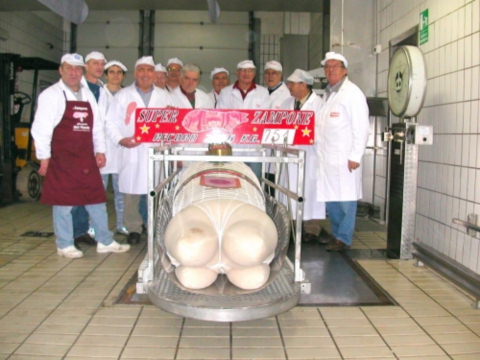
New Record Super Zampone 751 kg

You know Italians are serious about pork and dried meats when the best butchers get together every year to make the largest Zampone in the world. Since 1989 the city of Castelnuovo di Rangone, in the province of Modena, has hosted the Annual FESTA DELLO ZAMPONE PIU' GRANDE DEL MONDO. This year’s masterpiece is 751 kg. I know that many Americans grimace at the thought of Zampone. Last year I wrote about one the most widely used dishes on New Years Day, Lentils and Zampone. By the comments it was clear that most thought, “ughhh, that’s gross!”

This reaction is a result of our industrially processed and packaged culture. Who among us does not love Balogna? Sometimes Bologna is known as Baloney, or the Italian immigrant’s spelling of Bologna, the dried meat most widely used in the city. Bologna and Modena, two sister cities just a few kilometers apart in Emilia Romagna, make Mortadella. Baloney is actually the Italian immigrant’s version of Mortadella. Now here is the trick. Zampone is very similar to Mortadella. Both are various cuts of pork, mixed with various spices or herbs, and allowed to cure. Zampone is a celebration of the best cuts of pork. It is reserved for the highest of holidays. It is a specialty, something to prepare on a rare occasion.

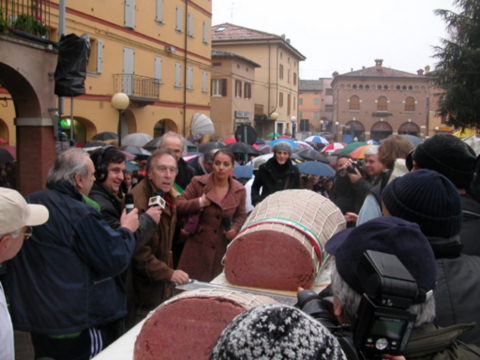
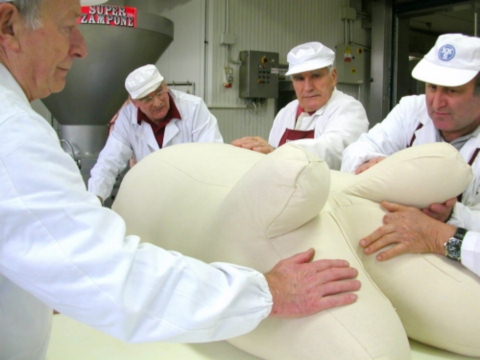
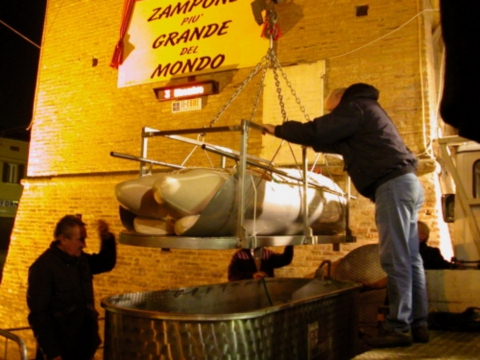
Every year on the first Sunday of December the Master Butchers of Castelnuovo offer Zampone to all who wish to participate. The one objective is to make a Zampone bigger than the previous year’s production. In 2005 they failed miserably coming up almost 100 kg light but this year’s Zampone beat all records. The Zampone is made of linen. It is then filled with the top cuts of pork with as many as 20 butcher’s working at the same time. The Zampone is completely on the 30th of November and then cooks for 60 hours in a special stainless steel pot. Sunday morning, at 11:00 the cooked Zampone is then offered, along with accompanying Lambrusco and Parmesan cheese, to thousands of visitors. The actual data is impressive:

Weight: 751 kg (1,652 lbs)
Length: 3.10 meters (Just over 10 ft.)
Diameter: 1.4 meters
Total cooking time: 74 hours
People served: 6,000
Consumed in: 1 hour!

This is a party! It is fun and if you have the opportunity to be in the area of Bologna for the first Sunday in December this is a must see!

Tags:

Labels: , , , ,

Read the Full Story...

Tuesday, December 27, 2005

Zampone con Lenticchie

Zampone with Lentils

Zampone is a primary dish across Italy during the Holiday period. In northern Italy the use of Zampone continues throughout the winter season. The most common dinner for Zampone is New Year's eve together with Lentils. In Bergamo and some parts of Brianza they call Lentils "denari" or coins. The tradition is that each lentil represents a coin to be earned during the year and Zampone which is ground pork stuffed in the skin of a pig's leg is the purse. Zampone is usually a 75% meat to 25% fat mix. Additionally the snout and other pieces considered delicacies may be included. The meat, coarsely chopped or ground, as if it were Salami meat is then mixed with salt, pepper, cloves, garlic, nutmeg and some red wine. The pigskin or "cotenna" is cleaned with vinegar and the pig foot is left on. Finally the meat mixture is placed in the skin, wound and tied. It is then left to cure at about 68 degrees and 50-55% humidity. One day I will tell you how I learned to prepare Zampone.


Zampone has long been a favorite in Italian families. The origin is most reputably from Mirandola in the 1500s. At that time there was a war between the French and the Italians regarding who was the rightful heir to the papacy. Mirandola was a fortified city fighting to maintain its independence from the Duke of Modena. The castle walls, in form of an eight-point star, were impenetrable but the ruling family was full of strife. Seeking to increase their commercial standing they created an alliance with France while Modena was aligned with Rome. This choice led to two primary sieges during the 1500. The first attack by the warrior Pope Giulio II and later by Giulio III.

During the 1510-1511 siege the people of Mirandola were sure the city would fall. To assure themselves that nothing of value was left for the enemy so they killed all of their pigs. This created a different problem: How to use all of the meat? They were under siege and needed all of the foodstuffs available. One of the Chefs to the court suggested that the meat be cut into small pieces, mixed with herbs, spices and salt for conservation to be cooked at a later time as needed. Since it was winter, and winter in that area is very cold, they were not concerned about the eventual degradation of the meat. The same meat mix is used to make Cotecchino, which, instead of the pigskin, uses the intestines as casings.

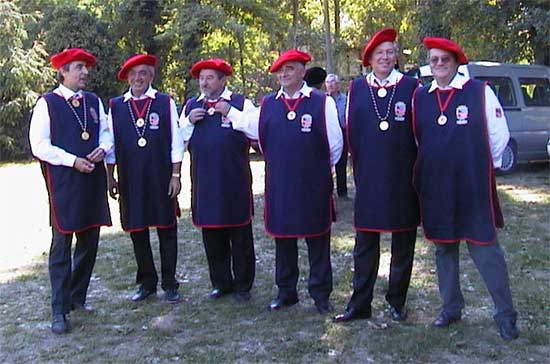
Zampone is an important. Zampone will be found at the Italian dinner table for New Year’s eve just as Turkey is found in the US for Thanksgiving. It is so important that a fraternity exists to protect the origin and quality of Zampone. Here they are.

Cooking Zampone is not extremely difficult but you must pay attention and go slowly. Today, most places that will supply uncooked Zampone will also have a cooked version available.

Preparation Zampone:

Place the Zampone in cold, unsalted water the night before. Allow to soak overnight so the Zampone will release much of the salt used in the curing process. The following morning remove the Zampone from the water and place on thin cotton kitchen towel. Make several small incisions under the nails of the pig foot and, with a large fork, punch several small holes along the length of the Zampone. This is to release the steam that will accumulate inside and avoid bursting the casing.

Roll rather tightly the Zampone in the kitchen towel and tie off the ends of the towel with cooking twine. Place in large pot with abundant cold water. Do not add salt or any other seasoning. Turn the heat on medium low (if you do not have a medium low then use low) and allow to cook for at least 3 hour per 2 lbs.


Ingredients Lentils
400 grams (about 1 lb.) of Dry Lentils
1 Carrot
1 Onion
1 Stalk of Celery
½ cup Red Wine
1 cup Tomato crushed
Olive Oil
Salt
Pepper

Preparation Lentils:

The night before (at least 12 hours) place the dry lentils in a bowl of cold water. Allow to sit for at least 12 hours.

Drain the lentils. Chop the celery, onion and carrot into small pieces. Place in a large pot with 3 tablespoons of Olive Oil and sauté over medium heat. When the onions are translucent add the lentils and the wine. Continue on medium heat until the ½ of the liquid has evaporated. Add the crushed tomatoes and ½ cup of water, cover and cook for an hour. Stir every 10 minutes.

To Serve:

Open the Zampone, cut into ½ inch slices and let the water drain. Create a base of lentils on a serving dish, with ¾ of the lentils, and arrange the disks of the Zampone on the lentils. Finally use the remaining lentils and sauce to dribble evenly over the Zampone. Serve hot with a hearty red wine. Some good choices could be a Barolo, Barbaresco, Valcalleppio, or Refosco, Brunello or other aged Tuscany . Avoid young reds and whites will most likely be overwhelmed.

Tags:

Labels: , ,

Read the Full Story...

Sunday, October 23, 2005

Dinner - Pork Chops with Pure

Yesterday I was exchanging emails with a good friend. She paid us a great compliment stating that our house was still the best Italian restaurant in Dallas. Well, not all would agree, however our food is true Italian. To kid with her a bit I sent the evening’s menu’.

Many times my wife and I start talking about a meal several days before. Then we go through our recipes, consult our books, and talk about it some more. The dinner table is an important part of Italian culture. Recipes are developed over generations based on which staples are locally available and passed down from generation to generation.

Even though it is just Raffaella and myself, the dinner table is an important part of our life. We spend hours talking, eating and just enjoying our time together at the table. In this light I thought I would add in our menu’ every once in awhile. Yesterday our evening was:

At 18:15, before we start cooking, Bruschetta (obviously made with the bread just baked and our balcony basil) accompanied by my version of a Rum Sidecar (1.5 oz. dark aged rum - .5 oz light rum - .5 oz Grand Marnier - .5 oz fresh lime juice).

Pork Chops in Lemon Butter Sauce with Pure'


Pure’ is Italian Mashed Potatoes.

First, in a heavy large frying pan at medium heat, a stick of butter is darkened, adding salt, pepper and sage. Once the butter has taken the flavors of the seasoning and the sage, the juice of ½ lemon is added. Take the heat to medium low. The chops get flattened to tenderize then cooked in the pan about 10 minutes on each side.

Once the chops are ready take them out of the frying pan, place them in the oven at about 150 F. just to keep them warm.

Add a glass of white wine to the hot pan and reduce to about ½ . Add a small handful of chopped Italian parsley and cook another 2 minutes.

At this point place 5 medium, peeled and thickly sliced potatoes into water and 2 tbls salt. Bring to a boil. Boil for 11 minutes. Place ½ stick of butter in the mixer bowl. Drain the potatoes and place the hot potatoes with the butter. Add salt, pepper and paprika to taste. Mash the potatoes and the melting butter with a fork, breaking down the potatoe's remaining consistency. Start the mixer at low speed, add ½ cup of heavy whipping cream. Slowly bring the mixer speed to the highest setting. After about 1 minute add 2 tbls of grated Parmesan cheese.

To put this together, Pure’ on the side and Chops in the middle. Smother both with the sauce and sprinkle a little chopped parsley on top. This is a traditional northern Italian dish so you want a crisp white wine. We chose a Pinot Grigio from Friuli.

If you try it please let me know your thoughts.

Tags:

Labels: , , , ,

Read the Full Story...