Thursday, August 23, 2007

Millefoglie and other Pastry Delights in Rome

MillefoglieTemptation is on every corner of every street. Fruit tarts stare at you from the protection of their refrigerated case. Quiet voices penetrate the surrounding street noise, whispering “we are so good and you can’t have us!” A round cream covered cake from the back row, emboldened by her smaller colleagues, becomes impertinent “Don’t even think about it with that life preserver permanently affixed to your waist!” The prodding continues as the Sacher Torta decides to wield the final blow without mercy, “Chocolate with apricot jam smothered in a dark chocolate ganasce will surely satisfy your growing craze but can you afford a new pair of pants?”

MimosaHow dare they challenge me? Such arrogance from a dessert designed to satisfy my sweet tooth and never ending chocolate craving. “I will have you,” becomes my immediate objective. No threat of losing the battle of the bulge will make me shrink away from such a worthy foe. I enter the store and quickly engage in taking control of those insignificant little treats.

MousseSome of you can appreciate my battle. Some will think I am superficial to give such importance to food. I confess, I have a sweet tooth. I love chocolate, fruity tarts, soft cakes covered in flavored creams and creampuffs of all sorts. Italy has many shops who take the art of baking to an entirely new level. In Rome one of these is the Pasticceria Cavalletti. Pasticcera Cavalletti in Via Nemorense has been making pastries since 1951. They produce their sweets by hand with fresh ingredients. There is no doubt about their professional capability. One nibble lets you know they know their business.

Some places will entice you with great looking presentations then you are somehow disappointed as the balance and flavour do not meet your expectations. Do not get me wrong the presentation is important but the natural flavours must explode. A perfect dessert is texture and flavour. I think about it like snuggling under the comforter on a cold winters morning. The experience is enveloping.

If you are in Rome and want to taste those Italian desserts the way they should taste then the Pasticceria Cavaletti, via Nemorense 179/181 is a stop for you.

Tags:


Labels: , , ,

Read the Full Story...

Wednesday, January 17, 2007

Italian Carnival Traditions - Smacafam – Kill the Hunger!

While many Italian Carnival Traditions make mock versions of traditional dishes, just as the costumes transform a normally quiet individual into a Don Giovanni, in Trentino a cake is made with a local pork sausage, pancetta and lard. The name, in local dialect, means Hunger Killer! The origins of the savory bread cake are not apparent most surely this is an antique recipe. Most scholars agree that the recipe dates well into the period of the Roman Empire. The first mention is in a cookbook written in the III century.

Trentino is located in the Alps. During the winter months it is cold, really cold and many of the locals would spend extended periods of time away from the shelter of the local town. A cake like this would be highly efficient when, carrying around a lot weight or bulky materials in the mountain passes would not have been the most intelligent of choices.

No matter where or when this combination of savory flavors and consistency was first put together it is a fantastic dish. Some recipes are timeless and reach across culinary boundaries like the Casatiello. I was even amazed to find that every American Italian Chef who has published a book or has a show, including the Food Network, presents his/her own version of this traditional Carnival specialty. This is unusual because not many dishes from Trentino make into internationally known cookbooks. Attention however, many of these recipes talk about Italian Sausage. In the US Italian Sausage is not really Italian. It is southern Italian and does not have Parmesan or Stracchino cheese and includes Fennel and other southern cooking herbs. The closest commercial product to the Lucanica or other Northern Italian sausages is Bratwurst. While Bratwurst does not use Parmesan cheese it does use nutmeg, cloves, and pepper.

An additional note is that some “famous” recipes use a mix of buckwheat and flour instead of simple buckwheat and milk instead of meat or chicken broth. Some say these differences are a sacrilege others believe this is the way it has always been. The choice is yours.

Ingredients:

¼ onion minced
2 ¼ cups (300 g) Buckwheat Flour (some recipes use 100 g buckwheat 200 g all-purpose)
2 (4 oz) Lucanica (Bratwurst or Northern Italian Sausage)
2 slices (1 oz) (thick cut into pieces) Lard, Pancetta or Bacon
2 ¼ cups (500 ml) cold Meat or Chicken Broth (some recipes use milk instead of Broth)
3 tbsp Olive Oil

Preparation:

Sift together the flour and salt into a large mixing bowl.

Preheat the oven to 375 degrees. Grease a large baking pan with Olive Oil.

In a skillet, place the Olive Oil, minced onions and lard (or pancetta, bacon). Cook over low heat for 4 minutes until the onion is translucent. Remove from heat and allow the mixture to cool completely.

While stirring the flour slowly pour in the broth. Mix in the onion-lard mixture and pour into the baking dish.

Remove the casing from the sausage and cut into disks. Distribute the disks evenly across the top of the dough.

Place in the oven and cook the salted cake for 40 minutes.

Remove and allow to cool before serving.

Tags:

Labels: , , , , , ,

Read the Full Story...

Monday, January 15, 2007

Cicerchiata – Italian Carnival Treats from Abruzzo

Cicerchie are small beans. They are an integral part of traditional recipes of Abruzzo however, they are becoming harder and harder to find. Only a few local farms in Abruzzo grow them, as the larger producers prefer the Ceci. Abruzzese traditions keep this ingredient of the comfort food alive. Throughout the year some pastry shops will make this traditional sweet of Carnival but in the month of January just about every family and restaurant will have a plate of Cicerchiata sitting around, tempting you every moment. These pastries are not beans instead they are a fried sweet bread about the size of small meatballs and glued together with oozing honey and candied fruit.

Most likely you will not find them elsewhere in Italy so a trip to this beautiful region is most likely the only way to try the original recipe. Some great wines to accompany this plate of gluttonous pleasure are Muffato della Sala, Verdicchio, and Falanghina. Every year during Carnival the town of Massa Lubrense, near Termini, holds the "Sagra delle Cicerchie".

Ingredients for the Cicerchie:
2 cups (300 g) All-purpose Flour
1/4 stick (30 g) Butter
4 tbsp (30 g) Sugar
2 Eggs
¾ cups Dry White Wine
Olive Oil for Frying

Ingredients for the soft Brittle:

120 g Honey
120 g Sugar
Minced candied fruit.

Preparation:

Mix together the ingredients for the Cicerchie. The dough should be soft but not sticky. Cut the dough into four pieces. Roll each piece into a stick the size of a grissino. Cut the stick into equal parts (see the preparation of Gnocchi). Continue with the other 3 sticks.

Pour enough Olive Oil to create a base of about 1 inch of oil. Bring to frying temperature. Do not overheat. To check the temperature, fry one Cicerchie. Once at temperature fry the amount of one stick at a time and drain on a wire rack with paper underneath.

Mix the Sugar and Honey together in a large bowl. Add the Cicerchie and minced candied fruit and spread on a baking sheet covered with wax paper or put into form on a plate and allow the Cicerchie to cool to room temperature.


Cakes Available online


Tags:

Labels: , , , , ,

Read the Full Story...

Saturday, January 13, 2007

Italian Carnival Traditions - Mini Krapfen with Cream Filling

Krapfen, what is a Krapfen? For those in the US, a Krapfen is a jelly or cream filled doughnut. For those from Vienna it is a traditional dessert and in Milan it is an occasional substitute for the cornetto with cappuccino for breakfast but along the border between Italy and Austria the Krapfen is Carnival. Carnival traditions are regional, they maintain local customs and represent regional culture. These Carnival treats require more time than Apple Fritters but are greatly appreciated. They can be found in most bars and pastry shops in northern Italy but for a real treat try making them at home and consuming while still warm. Local tradition fills the Krapfen with Crema Pasticerra other regions will use fruit jams or liquored fruits.

A clean crisp white wine such as a Pinot Grigio or Prosecco are my favorite wines for these little delights.

Ingredients:

Crema Pasticcera for the filling
3 ¾ cups (500 g) all-purpose flour
¼ cup warm Water
1 cup warm Milk
1 tbsp Sugar
2 packages (14 g) active dry yeast
1 stick (110 g) softened butter
½ tsp salt
½ tsp vanilla
Peel of 1 Lemon
Powdered sugar

Preparation:

Mix the sugar in the warm water. Dissolve the yeast in water-sugar. Let the yeast sit for 5 minutes.

In a small bowl mix together the flour and yeast-water. Cover with a damp towel and let the dough rest for 30 minutes.

Place the remaining dry ingredients in a large bowl. Add the eggs, milk, softened butter, vanilla and grated peel of 1 lemon. Mix together thoroughly. Add the yeast ball and knead on a floured surface until the dough no longer sticks to the fingers. Kneading for this type of dough means throwing the dough onto a hard surface, folding back together and then throwing again.

Finally roll the dough into a ball and place in a large, buttered, bowl. Cut an X in the top of the dough ball and cover with a damp towel. Let the dough rise for 2 hours.

Roll the dough to a thickness of ½ inch. With a glass or round cutter cut 2 inch diameter disks. Sprinkle flour over a clean kitchen towel and cover the cut dough disks. Let the dough rise for 2 hours.

Frying: Using a skillet, Dutch oven or fryer heat a clean frying oil, I use Olive Oil but many prefer peanut or Sesame oil. Do not overheat this will cause the Krapfen to absorb more oil. Place the dough disks in the hot oil. A normal skillet will take about 6 Krapfen at a time. Let the dough cook until golden brown. Flip the dough and let cook until golden. Remove and allow the Krapfen to drain on a wire rack for at least 2 minutes.

Once the Krapfen is cool enough to pick up with a bare hand cut the Krapfen in half like a hamburger bun. Fill the center with Crema Pasticcera and close. For the more adventurous, fill a cake decorator’s icing bag with Crema Pasticcera. Choose a large nipple (about the size of a woman’s pinky) and squirt the Crema Pasticcera into the center of the Krapfen.


Cakes Available online


Tags:


Labels: , , , , ,

Read the Full Story...

Friday, January 12, 2007

Italian Carnival Treats - Frittelle di Mele – Apple Fritters

Italian Holidays bring with them specialty dishes and desserts. These treats are made only during that particular celebration. Italian recipes are also very local. They are based on ingredients that grow locally and are abundant during the season. Carnival in Trentino-Alto Adige has given us a great treat, the Apple Fritter, in Italian shops it is called Frittelle di Mele. Today, during Carnival, you will find Apple Fritters just about anywhere in Northern Italy and from Bergamo to Trieste a visit to someone’s home will most probably lead to an unscheduled feast of these pastries.

They look like flat doughnuts and most likely are Austrian in origin because the pastella, the dough used to cover the apple slice, is the same used for many types of Krafen. Once dipped in the slightly sweet dough they are fried in Olive Oil. Naturally sweet and powdered with confectioners sugar these pastries are a favorite kids for midmorning and afternoon snacks.

Remember that with recipes that depend on simple and balanced flavors instead of sugar you need to find the best quality ingredients available. Try a farmer’s market for the apples, it may be farther away than your local supermarket but the end result will be significantly better. When you make these delights, try them with an Alto Adige Moscato Giallo.

Ingredients for 4 people:

6 Granny or 4 Golden Apples
1 ¾ cups (200 g) all-purpose Flour, sifted
2 Eggs
1 package (7 g) Active Dry Yeast
Peel of 1 lemon grated
½ cup (130 ml) warm Milk
½ stick (50 g) unsalted melted Butter
5 tbsp sugar or 1 ½ oz. Grappa (if using Grappa eliminate adding sugar to the flour)
Pinch of salt

Olive Oil to fry the Fritters
Cinnamon
Powdered Sugar

Preparation:

Dissolve the yeast in the warm milk. Let the yeast activate for 5 minutes.

Sift together the salt, flour and sugar (if not using Grapa).

In a mixing bowl, mix together the milk-yeast, lemon peel, grappa (if using), melted butter, and eggs. While it is not necessary to beat the eggs they should be well broken.

Begin adding the flour mixture to the liquids, stirring with a large spoon. Continue adding flour until the mixture is firm but could not be worked by hand. Depending on the humidity this may occur before or after the amount of flour indicated has been incorporated. Adjust with more or less flour until the consistency is that of a liquid paste.

Cover with plastic wrap or a damp towel and let the dough sit for one hour.

Once the hour has passed. Place Olive Oil in a heavy skillet or Dutch oven over medium to medium-low heat. Do not overheat the oil. Olive Oil has a low burning temperature. To test the temperature, place a small amount of dough in the hot oil. The dough should turn golden within a few minutes. If the dough turns dark brown reduce the heat.

While the oil is heating, core and peel the apples. Cut into slices about ½ to ¾ inch thick. Immerse the apple slices the dough and turn over to coat evenly. Be careful not to break the apple ring. With a fork, place the fritter in the hot oil. You can place 5 or 6 fritters in the oil at one time. Allow them to cook until golden with just a hint of brown. Turn the fritters over and allow sufficient time for the fritters to cook.

Remove from the oil and drain on a metal rack. Just before the next batch is ready move the drained fritters to a plate, sprinkle with powdered sugar or cinnamon or both.

Note: The oil temperature will allow the discerning cook to change the consistency of the treat. With a higher temperature the apple will not soften as much while the dough is cooking and will maintain some of the citrus bite while a lower temperature will cook the apple more caramelizing the natural sugars in the apple making the fritter sweeter.

Tags:

Labels: , , , , ,

Read the Full Story...

Thursday, November 16, 2006

Italian Christmas Tradition – Torrone from Cremona

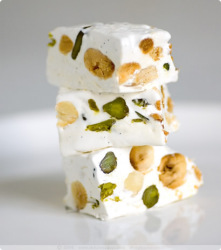
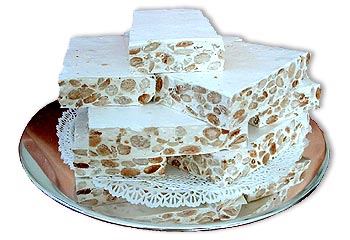
An Italian Christmas Tradition, the Turun or Torrone of Cremona, has conquered the world. Almost every Italian little town has their own recipe as does just about every Southern European town. Yes the Torrone of Cremona, now widely distributed year round in US grocery stores, is an Italian Christmas delight. The origins of Torrone are a bit more confused than the success of the natural candy bar.

The most widely accepted version tells of the master chef of Cremona created this sweet in 1441 on the 25th of October in occasion of the nuptials of Francesco Sforza and Bianca Maria Visconti. A wedding that would bring together the two most powerful families of the known world. That must have been some wedding; the dowry was the City of Cremona. Some say Torrone was created in order to use the egg whites left over after preparing thousand of pastries while others indicate that Turun and Cupedia were versions of the Arab and Roman Empires respectively. Both of these sweets would have origins several hundred years before Christ.

Since I was not around at the time, I will simply narrate what is written and what seems probable. The scribes of the Sforza family indicate that the master chef of Cremona created a compact dessert of almonds, honey and egg whites. The dessert was a sculpture of the Bell Tower of the Duomo of Cremona, said Torrazzo and in those years called Torrione, in English “Really Big Tower.”

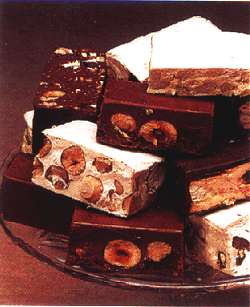
Whether Torrone was initially created during the Roman Empire or in occasion of the Sforza wedding, Torrone is synonymous with Cremona. Its production is one of Cremona’s primary industries. The natural goodness of this antique candy has taken over the world. Originally Torrone was rock hard. I mean break your teeth hard and while this original version is not as easy to find, it is the only Torrone for the truly passionate. Today you can find soft Torrone, Chewy Torrone, Torrone covered in Chocolate, Torrone with Hazelnuts or citrus and many other versions.

Until recent years Torrone was available from October through January and associated with Christmas. Today it can be found throughout the year and is a good substitution for the industrial candy bars. That is not to say that this treat does not have a lot of calories, simply that it is an antique recipe and most likely will not rot your teeth, it may break them if you are fortunate to find an original version, but it will not rot them.

The best thing about Torrone is that it is not difficult to make and can be easily adapted to just about any taste.

Ingredients:

8 oz. (250 g) Hazelnuts
10 oz. (320 g) Almonds
8 oz. (250 g) Honey
11 oz. (320 g) Sugar
3 egg whites
Grated peel of one orange
1 3/4 oz. (50 g) candied orange peel
2 tbsp Brandy
1 tsp Vanilla Extract
10 Communion wafers (or other thin wafer)

Preparation:

If the almonds still have the skin. Blanch the almonds in boiling water for 3 minutes. Drain and dry.

Heat the oven to 350 degrees. Place the almonds on a baking pan with parchment paper. Toast for 5 minutes. Rub the almonds in a towel, the skins will come off in the towel.

In a double boiler, over medium heat, pour the honey. Let the honey cook for about 1 hour. Stir occasionally with a wooden spoon.

Place the candied orange peel in a small cup. Add the Brandy and let sit while the honey cooks.

When the honey is blond in color, whip the egg whites to firm peaks. Slowly, add the egg whites to the honey, mixing from bottom to top, never side to side. The honey will swell up and foam.

In a separate pan heat the sugar. When the sugar starts to brown, add the sugar to the honey-egg white mixture, stirring continuously. The mixture will begin to lose volume and become thicker.

To see if the mixture is ready, drop a teaspoon of the mixture into cold water. The cold water will immediately bring it to its consistency. You can verify if it is at the hardness you desire. If you want it harder just continue cooking a bit longer.

Drain the candied orange peel. Add the remaining ingredients, except the wafers, to the mixture. Stir quickly and try to distribute the hard ingredients evenly in the paste.

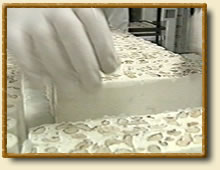
Place the 1/2 of the wafers on a hard surface, preferably marble or granite. Pour the mixture onto the wafers. Mold the now hardening mixture into a rectangle about 2 inches high. Smooth the top of the mixture and place the remaining wafers. Press gently and allow to cool completely. The Torrone can now be cut into pieces of any size.

Tags:

Labels: , , , , ,

Read the Full Story...

Saturday, September 30, 2006

Turta de Lac – Torta di Pane – Torta del Paese

Sacrilege! A French recipe on this exclusively Italian site. Mon Dieu! I have not lost my marbles, notwithstanding the appearance, this is an authentic and antique Italian recipe. My early years in Italy were spent in a small town in Brianza, about 15 km. Northeast of Milan. These were the days of 5:45 AM bus rides to the outskirts of Milan to catch the Metro and walking the last 3 km home from the closest bus stop at 9:00 pm because the bus stopped service before I finished work.

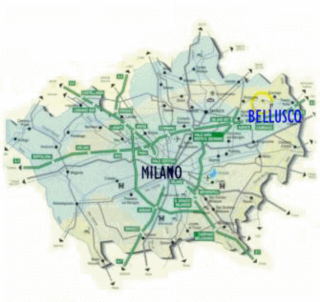
The little town, built around a medieval castle, counted about 3,000 people. The closest town was Bellusco, much larger in size, about 6,000 people. To be exact, the town has 6,070 individuals, 3,113 women and 2,957 men. Bellusco origins date back well into the Roman Empire but is officially recognized in the writings of the Bishop of Bergamo in 898. In this area the local dialect is Brianzolo a more provincial version of Milanese. There are still numerous individuals who do not speak Italian, I know several. Brianzolo, as Milanese, has significant French influences. In fact on my trips to provincial France I do not attempt French instead I speak Brianzolo and we get along just fine.

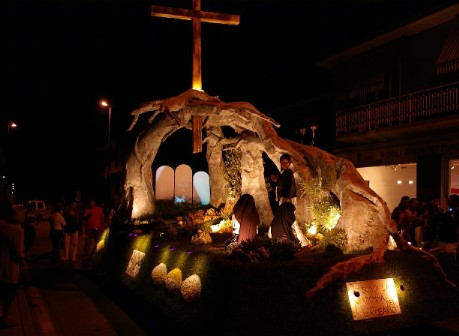
In the six years spent in this area, Ferragosto initiated my favorite time of year. The temperatures dropped quickly and the traditional winter dishes of Polenta, Casoeula, Salamelle, and Brasato. The second Sunday of September, Bellusco celebrates its patron saint, Santa Giustina. They even have a palio but this is not the reason I looked forward to the Festa del Paese.

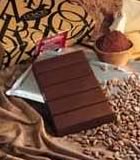
I love chocolate, real chocolate, not milk chocolate or white chocolate but dark 65% and above Cocoa Butter chocolate. I even like the 100% chocolate that others have referred to as asphalt. Once a year, for the celebration of the patron saint, the Turta de Lac or Torta del Paese appears. When I first tried this torta I was hooked. It is marvelous, a chocolate cream pie, a chocolate mousse, brownies and dark fudge all rolled into one cake.

Turta de Lac is antique. The recipe passed down through the generations never written from mother to daughter. Preparation was not by quantity, instead by the feel. Since the Turta de Lac is prepared only once a year, the stale bread was accumulated in the dispenser until the time of preparation. The stale bread, traditionally the Michetta, is placed in the family milk pale. Milk is added and the mixture sits over night. In the morning cookies (Biscotti) and Amaretti are crumbled and added until the mixture is dark brown. Then the special family ingredients are added and the Turta de Lac is carried to local bakery to be cooked. The number of Turta de Lac prepared by each family could feed a battalion of hungry soldiers. The Turta de Lac will remain fresh for several days and tradition requires that each family share its production with the extended family and friends.

The recipe here is one I acquired from a seventy year young, matriarch. She considers it the only right one but others will have their own recipe with small variations. These are family recipes and may be hundreds of years old, passed down from matriarch to daughter. No matter the recipe used, they are all marvelous. Should you see the Turta de Lac on the dessert table during this period, try it!

Ingredients for a 9 inch spring-form pan:

4 stale Michette or Rosette (these are buns)
70 gr. Bakers Cocoa Powder
100 gr. Raisins
125 gr. Amaretti Biscotti (you can find these at Whole Foods or gourmet food shops)
50 gr. of Pinoli
750 ml milk (about 3 cups)

Preparation:

The night before, place the stale bread in large bowl. Add the milk, cover and let stand overnight.

Dissolve the Cocoa Powder in a bit of milk. Add the Cocoa Powder to the Bread/Milk mixture. With a large spoon beat the bread/milk mixture until smooth. Crumble the Amaretti and add to the milk. Stir in the Pinoli and Raisins.

Butter the bottom and sides of the pan. Place parchment paper or wax paper in the bottom of the pan.

Pour into the spring-form pan, cover with plastic wrap and rest for a couple of hours.

Preheat the oven to 375. Remove the plastic covering the spring-form pan and bake for 45 minutes. Remove from the oven and rest for 30 minutes. Slide a knife around the sides and remove the sides of the pan.

Cover and refrigerate when the Turta de Lac is at room temperature.


Cakes Available online


Tags:

Labels: , , ,

Read the Full Story...

Monday, August 28, 2006

Chocolate Mousse – Exponential Decadence Realized

Chocolate Mousse is one of the purest forms of luxurious decadence. The intense dark chocolate color oozes upward out of the cup. The velvety cream folds onto itself, defying gravity. Smooth rounded ridges climb the mountain of delight to the curly peak. Shaved dark chocolate and a dollop of whipped cream are clouds of early fall before the snow falls.

I love chocolate. I love great chocolate, no milk chocolate with sugars or the too sweet white chocolates but the simple, very intense, cacao butter chocolate. My good friend from Porto di Ripetta in Rome introduced me to the basics of this chocolate mousse knowing my passion for truly intense chocolate expressions. He perfected the signature recipe for his family restaurant in Rome and I have modified it for my personal obsession with chocolate. For the milk chocolate people a spoonful will be more than enough. For the chocoholics a 4 oz. portion should suffice but for the truly insane chocolate lovers the full 6 oz. portion will satisfy, as no other fix, your needs.

If chocolate is aphrodisiac, a full 6 oz. portion of this sinful mousse will release the deepest and most basic passion in your partner. Dose it well.

Ingredients for 8 servings:

12 oz. (325 g) Dark unsweetened chocolate 65-85% butter cacao (bar form) cut into small pieces
(The Porto di Ripetta version uses 8 oz (220 g) dark chocolate)
½ cup (110ml) Milk
2 cups (440 ml) Heavy whipping cream
4 egg yolks
¼ cup sugar
1/3 (75 ml) cup coffee
Chocolate shavings or whipped cream

Preparation:

You will need a double boiler and two pots for the preparation of this dessert.

Whip the heavy cream to soft peaks. Cover with plastic wrap and place in the refrigerator.

Bring the double boiler water to a boil. Place the egg yolks in the pot and whisk in the sugar. Continue whisking over the boiling water for about 3 minutes until the yolks start to thicken. Continue whisking while the yolks cool, about 5 minutes. The yolks will take on a creamy texture with white streaks on top. Set aside.

Remove the whipped cream from the refrigerator.

Place the chocolate bits, coffee and the milk in the second double boiler pot. Turn the heat off once the water boils, mix the chocolate and milk. Turn the heat off. Whisk until the chocolate completely melts. Do not overheat. Remove from the hot water and whisk the chocolate into the egg-sugar mixture.

With a spatula or wooden spoon, fold in the whipped cream. Remember when folding egg whites or whipped cream, always use a bottom to top motion. Never use circular or downward strokes.

Pour into parfait glasses, small bowls or cups. I use porcelain tea cups which hold their temperature very well and give the guest something to hold onto without putting their hands onto the dessert container (this would warm the semi-freddo).

Cover with plastic wrap and refrigerate at least 1 hour before serving. When serving remove from the refrigerator at least ½ hour before presentation. Add whipped cream, chocolate shavings or both just before presenting this gift to your guest.

I would serve this with a structured red wine. Bricco Asili Barbaresco, Chianti Classico Castello Monastero, Romitorio Di Santedame 2000, and Capezzana Ghiaie della Furba 2000 are all marvelous choices.


Cakes Available online


Tags:

Labels: , , ,

Read the Full Story...