Friday, January 19, 2007

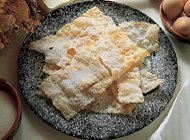
Frittelle di Carnevale – Carnival Fried Pastry Treats

Traveling through Italy in the months of January and February Carnival sweets appear in most local shops and bars. Many are similar, fried dough with a hint of grappa, apples and or lemon. They are a bit greasy and covered with powdered sugar. I would suggest using a napkin as a makeshift bib before biting into one of these babies otherwise all will know about your sweet discretion. Without a doubt they represent Carnival. They are fun, tasty sweet and just the sight invokes thoughts of dinners, costumes and elaborate parties.


Carnival is a holiday for kids of all ages, perhaps this is the reason I enjoy it so much. It may be the thoughts of my girls begging to stop and get a thick hot chocolate with these fried pastries on the way to school that makes me stop and enjoy this tradition every year. It may be that they are just sweet enough or the fun sound they make as they crunch under your teeth. It may even be the contortions necessary to avoid being covered with powdered sugar but whatever the reason the sweets of Carnival are a must during any visit in this period.

Ingredients:

3 cups all-purpose Flour
3 Eggs
1 cup warm Milk
6 tbsp Sugar
½ tsp Vanilla
4 oz Raisins
1 package (8 g) active dry Yeast
Olive Oil to fry with
2 Apples grated
1 tbsp grated Lemon peel
a pinch of salt
1/2 cup of Grappa

Preparation:

Place the raisins in a bowl and fill with water. Let the raisins soak for 15 minutes and then drain.

Dissolve the yeast in the flour. Let the mixture rest for about 10 minutes.

Place the flour, salt, and sugar in large mixing bowl. Add the eggs, vanilla, grated lemon peel, grated apples, yeast-milk and grappa. Stir the mixture together well with a wooden spoon.

The dough will be elastic and a bit sticky. Knead in the raisins.

Cover with plastic wrap or a damp towel and let the dough rise for 30-45 minutes.

Over medium low heat bring the oil to temperature in a large skillet, Dutch oven, or fryer.

On a lightly floured surface, roll the dough into a rectangle about ¼ to ½ inch thick. With a pizza knife cut the dough into diamonds.

Fry until golden on each side, drain on a wire rack or absorbent paper. Place in a serving dish and cover with powdered sugar.


Cakes Available online


Tags:

Labels: , , , ,

Read the Full Story...

Wednesday, January 17, 2007

Italian Carnival Traditions - Smacafam – Kill the Hunger!

While many Italian Carnival Traditions make mock versions of traditional dishes, just as the costumes transform a normally quiet individual into a Don Giovanni, in Trentino a cake is made with a local pork sausage, pancetta and lard. The name, in local dialect, means Hunger Killer! The origins of the savory bread cake are not apparent most surely this is an antique recipe. Most scholars agree that the recipe dates well into the period of the Roman Empire. The first mention is in a cookbook written in the III century.

Trentino is located in the Alps. During the winter months it is cold, really cold and many of the locals would spend extended periods of time away from the shelter of the local town. A cake like this would be highly efficient when, carrying around a lot weight or bulky materials in the mountain passes would not have been the most intelligent of choices.

No matter where or when this combination of savory flavors and consistency was first put together it is a fantastic dish. Some recipes are timeless and reach across culinary boundaries like the Casatiello. I was even amazed to find that every American Italian Chef who has published a book or has a show, including the Food Network, presents his/her own version of this traditional Carnival specialty. This is unusual because not many dishes from Trentino make into internationally known cookbooks. Attention however, many of these recipes talk about Italian Sausage. In the US Italian Sausage is not really Italian. It is southern Italian and does not have Parmesan or Stracchino cheese and includes Fennel and other southern cooking herbs. The closest commercial product to the Lucanica or other Northern Italian sausages is Bratwurst. While Bratwurst does not use Parmesan cheese it does use nutmeg, cloves, and pepper.

An additional note is that some “famous” recipes use a mix of buckwheat and flour instead of simple buckwheat and milk instead of meat or chicken broth. Some say these differences are a sacrilege others believe this is the way it has always been. The choice is yours.

Ingredients:

¼ onion minced
2 ¼ cups (300 g) Buckwheat Flour (some recipes use 100 g buckwheat 200 g all-purpose)
2 (4 oz) Lucanica (Bratwurst or Northern Italian Sausage)
2 slices (1 oz) (thick cut into pieces) Lard, Pancetta or Bacon
2 ¼ cups (500 ml) cold Meat or Chicken Broth (some recipes use milk instead of Broth)
3 tbsp Olive Oil

Preparation:

Sift together the flour and salt into a large mixing bowl.

Preheat the oven to 375 degrees. Grease a large baking pan with Olive Oil.

In a skillet, place the Olive Oil, minced onions and lard (or pancetta, bacon). Cook over low heat for 4 minutes until the onion is translucent. Remove from heat and allow the mixture to cool completely.

While stirring the flour slowly pour in the broth. Mix in the onion-lard mixture and pour into the baking dish.

Remove the casing from the sausage and cut into disks. Distribute the disks evenly across the top of the dough.

Place in the oven and cook the salted cake for 40 minutes.

Remove and allow to cool before serving.

Tags:

Labels: , , , , , ,

Read the Full Story...

Tuesday, January 16, 2007

Italian Carnival Sweet Treats - Tortelli di Milano

Do not let the name fool you. Tortelli di Milano, “Tortei de Carnevaa a la Milanese” in the dialect from Milan, are not your pasta tortelli filled with meat or cheese. They are fried sweet dough, similar to doughnuts, covered with sugar and cinnamon. Many Italian Carnival holiday traditions include a sweet version of an everyday dish as if to imitate the concept of Carnival where things are never what they seem to be. These bite size delights appear in the middle of January and are gone by the end of February. They are perfect for mid morning or early afternoon snacks. I first experienced these desserts on a cold January evening in Milan while waiting for the tram after a long day at the office.

The air was cold, the wind strong and the fog had established its control for the night. That wet cold penetrates your bones no matter how many layers of clothes and sweaters you are wearing. While others were already at home getting ready to sit at the dinner table I was, as usual, waiting for the first leg of my 1 ½ hour trip home. Fortunately the tram stop was right in front of a bar, not an unusual occasion considering the number of bars in Milan. Before catching the tram I would drink a “China Calda”, a steaming hot orange flavored liquor. I walked into the bar, greeted my good friend behind the counter, and saw a tray of these puffs with cinnamon and sugar.

I decided it was time to change my usual routine. I ordered a hot chocolate, thick and gooey steaming hot chocolate and a couple of the pastries. They were sweet, soft, and the cinnamon created a beautiful sensation of flavors. Chocolate and spices is a marvelous combination. I completed the long trip home, still warm inside and decided this was a new addition to my favorite traditions. Just as quickly as they had arrived on the scene they disappeared a couple of days after “Giovedi Grasso” and China Calda returned to its previous place as before. Without a doubt Carnival is one of my favorite holidays and I look forward to those cold days when the Tortelli di Milano make their appearance in the bars and pastry shops.

Ingredients:

1 ¼ (150 g) All-Purpose Flour
½ stick (50 g) Butter
¼ cups (50 g) Sugar
2 ¼ cups (500 ml) Milk
4 Eggs
2 tsp (12 g) Double Acting Baking Powder
1 Lemon Peel
½ tsp Vanilla
1 tbsp Rum
Olive Oil to fry with (or preferred frying oil)
Powdered Sugar

Preparation:

In a large pot, mix together the sugar, vanilla, milk, 2 1/4 cups (500 ml) of water, the butter cut into pieces, the peel of 1 lemon.

Bring the mixture to a boil.

In a separate bowl mix the baking powder and flour.

Remove from the heat and remove the Lemon Peel. Add the flour mixture to the liquid stirring briskly. Place the pot on the heat again and cook for 10 minutes continually stirring. The sough will separate from the sides of the pot, similar to the procedure for Bigne. Remove from heat and allow the dough to cool for about 5 minutes. Add the whole eggs, one a time, working with your hands if necessary. Add the Rum. Set aside.

Heat the frying oil in a heavy skillet or deep fryer. Test the oil temperature by placing a small amount of dough and watching it fry. The oil should not smoke and the dough should take on a golden color.

Use a tablespoon to create small balls of dough. Add them directly to the oil. Cook on both sides until golden. Remove from the oil and allow the Tortelli to drain on a wire rack. Serve hot with powdered sugar and cinnamon.


Cakes Available online


Tags:

Labels: , , , , , , , ,

Read the Full Story...

Saturday, January 13, 2007

Italian Carnival Traditions - Mini Krapfen with Cream Filling

Krapfen, what is a Krapfen? For those in the US, a Krapfen is a jelly or cream filled doughnut. For those from Vienna it is a traditional dessert and in Milan it is an occasional substitute for the cornetto with cappuccino for breakfast but along the border between Italy and Austria the Krapfen is Carnival. Carnival traditions are regional, they maintain local customs and represent regional culture. These Carnival treats require more time than Apple Fritters but are greatly appreciated. They can be found in most bars and pastry shops in northern Italy but for a real treat try making them at home and consuming while still warm. Local tradition fills the Krapfen with Crema Pasticerra other regions will use fruit jams or liquored fruits.

A clean crisp white wine such as a Pinot Grigio or Prosecco are my favorite wines for these little delights.

Ingredients:

Crema Pasticcera for the filling
3 ¾ cups (500 g) all-purpose flour
¼ cup warm Water
1 cup warm Milk
1 tbsp Sugar
2 packages (14 g) active dry yeast
1 stick (110 g) softened butter
½ tsp salt
½ tsp vanilla
Peel of 1 Lemon
Powdered sugar

Preparation:

Mix the sugar in the warm water. Dissolve the yeast in water-sugar. Let the yeast sit for 5 minutes.

In a small bowl mix together the flour and yeast-water. Cover with a damp towel and let the dough rest for 30 minutes.

Place the remaining dry ingredients in a large bowl. Add the eggs, milk, softened butter, vanilla and grated peel of 1 lemon. Mix together thoroughly. Add the yeast ball and knead on a floured surface until the dough no longer sticks to the fingers. Kneading for this type of dough means throwing the dough onto a hard surface, folding back together and then throwing again.

Finally roll the dough into a ball and place in a large, buttered, bowl. Cut an X in the top of the dough ball and cover with a damp towel. Let the dough rise for 2 hours.

Roll the dough to a thickness of ½ inch. With a glass or round cutter cut 2 inch diameter disks. Sprinkle flour over a clean kitchen towel and cover the cut dough disks. Let the dough rise for 2 hours.

Frying: Using a skillet, Dutch oven or fryer heat a clean frying oil, I use Olive Oil but many prefer peanut or Sesame oil. Do not overheat this will cause the Krapfen to absorb more oil. Place the dough disks in the hot oil. A normal skillet will take about 6 Krapfen at a time. Let the dough cook until golden brown. Flip the dough and let cook until golden. Remove and allow the Krapfen to drain on a wire rack for at least 2 minutes.

Once the Krapfen is cool enough to pick up with a bare hand cut the Krapfen in half like a hamburger bun. Fill the center with Crema Pasticcera and close. For the more adventurous, fill a cake decorator’s icing bag with Crema Pasticcera. Choose a large nipple (about the size of a woman’s pinky) and squirt the Crema Pasticcera into the center of the Krapfen.


Cakes Available online


Tags:


Labels: , , , , ,

Read the Full Story...

Friday, January 12, 2007

Italian Carnival Treats - Frittelle di Mele – Apple Fritters

Italian Holidays bring with them specialty dishes and desserts. These treats are made only during that particular celebration. Italian recipes are also very local. They are based on ingredients that grow locally and are abundant during the season. Carnival in Trentino-Alto Adige has given us a great treat, the Apple Fritter, in Italian shops it is called Frittelle di Mele. Today, during Carnival, you will find Apple Fritters just about anywhere in Northern Italy and from Bergamo to Trieste a visit to someone’s home will most probably lead to an unscheduled feast of these pastries.

They look like flat doughnuts and most likely are Austrian in origin because the pastella, the dough used to cover the apple slice, is the same used for many types of Krafen. Once dipped in the slightly sweet dough they are fried in Olive Oil. Naturally sweet and powdered with confectioners sugar these pastries are a favorite kids for midmorning and afternoon snacks.

Remember that with recipes that depend on simple and balanced flavors instead of sugar you need to find the best quality ingredients available. Try a farmer’s market for the apples, it may be farther away than your local supermarket but the end result will be significantly better. When you make these delights, try them with an Alto Adige Moscato Giallo.

Ingredients for 4 people:

6 Granny or 4 Golden Apples
1 ¾ cups (200 g) all-purpose Flour, sifted
2 Eggs
1 package (7 g) Active Dry Yeast
Peel of 1 lemon grated
½ cup (130 ml) warm Milk
½ stick (50 g) unsalted melted Butter
5 tbsp sugar or 1 ½ oz. Grappa (if using Grappa eliminate adding sugar to the flour)
Pinch of salt

Olive Oil to fry the Fritters
Cinnamon
Powdered Sugar

Preparation:

Dissolve the yeast in the warm milk. Let the yeast activate for 5 minutes.

Sift together the salt, flour and sugar (if not using Grapa).

In a mixing bowl, mix together the milk-yeast, lemon peel, grappa (if using), melted butter, and eggs. While it is not necessary to beat the eggs they should be well broken.

Begin adding the flour mixture to the liquids, stirring with a large spoon. Continue adding flour until the mixture is firm but could not be worked by hand. Depending on the humidity this may occur before or after the amount of flour indicated has been incorporated. Adjust with more or less flour until the consistency is that of a liquid paste.

Cover with plastic wrap or a damp towel and let the dough sit for one hour.

Once the hour has passed. Place Olive Oil in a heavy skillet or Dutch oven over medium to medium-low heat. Do not overheat the oil. Olive Oil has a low burning temperature. To test the temperature, place a small amount of dough in the hot oil. The dough should turn golden within a few minutes. If the dough turns dark brown reduce the heat.

While the oil is heating, core and peel the apples. Cut into slices about ½ to ¾ inch thick. Immerse the apple slices the dough and turn over to coat evenly. Be careful not to break the apple ring. With a fork, place the fritter in the hot oil. You can place 5 or 6 fritters in the oil at one time. Allow them to cook until golden with just a hint of brown. Turn the fritters over and allow sufficient time for the fritters to cook.

Remove from the oil and drain on a metal rack. Just before the next batch is ready move the drained fritters to a plate, sprinkle with powdered sugar or cinnamon or both.

Note: The oil temperature will allow the discerning cook to change the consistency of the treat. With a higher temperature the apple will not soften as much while the dough is cooking and will maintain some of the citrus bite while a lower temperature will cook the apple more caramelizing the natural sugars in the apple making the fritter sweeter.

Tags:

Labels: , , , , ,

Read the Full Story...

Wednesday, January 10, 2007

Carnevale Italiano – The History of Italian Carnival

There are numerous versions regarding the history of the festivities of Carnival or Carnevale Italiano. Most begin in the 1400s but the most reliable seems to tie the Christian celebration of Carnival with the Roman Empire’s pagan celebration of the Saturnali. The Saturnali are the celebrations from December to March of the Roman version of the Greek God Zeus, or father of the gods. The first real information is found in 1268 where the first costumes, known as Maschere, were prohibited in the casinos of Venice. Venice is seems to have exalted the festivities and also to have been the place where the Catholic Church did its best to eliminate it.

In the early 1300s masks were prohibited in church and when large groups would assemble in the streets. In 1487 the youth of Venice rebelled and created the group of the socks. The members were primarily young adults from wealthy noble families who would parade around town in costume, have a great time and distribute food to the poor.

In Medieval the use of masks, costumes, parades and celebrations took root in the cities across Europe. They were seen as a way to equalize the people, eliminating connotations of rich and poor, educated and ignorant. Carnival was a time for the people to unite and to have fun before the 40 days of Lent, which meant penitence, fasting and prayer. During this period the streets would fill with fire eaters, parades, puppet shows, dancers, coriandoli and Stelle Filanti (rolls of colored paper the open when thrown like falling stars). It was also a time when the people from the various quarters of the city would go into neighboring sectors and throw flour on the people, carry clubs of straw to imitate battles and generally create a great ruckus.

In the 1600s the Church struck back supporting a law prohibiting the use of masks all year long except in official occasions. The Penalties for transgression were severe. But again the people fought back and in 1776 a populous movement was able get the “Family Honor” act that required women to wear masks and full traditional epic costumes to the theater. Again the anti-fun club significantly hindered the celebrations of Carnival when the Austrian Empire took over Italy in the XVIII century. The Austrians did not understand the importance of the theater, the parades, costumes and the masks. They prohibited everything and it took another 200 years for Carnival to return. Unfortunately the theatrical folkloristic representations, costumes and stories did not recover. Today only the parades, sometimes kids with flour running the streets and masks during the last week of Carnival survived.

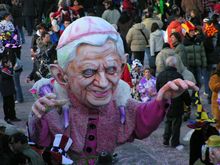
Today parades represent current political, religious and cultural themes. Masks represent celebrities but in Venice and Viareggio you can still find the traditional Carnival.

Tags:

Labels: , , , ,

Read the Full Story...

Monday, January 08, 2007

Italian Carnival Festivities, Costumes, and History

The Apostle Paul advised, "When I was a child, I spake as a child, I understood as a child, I thought as a child: but when I became a man, I put away childish things" (1 Corinthians 13:11). I admit this is not me, I guess I am not a good Christian. I love life, our culture, our history and learning about the things that make us who we are! As I grow older the manly things seem less and less important. The grey hairs on my temples and in my beard must not be a sign of wisdom instead I embrace the fleeting moment that is now.

Carnival is not widely celebrated in the US. The transgression is limited to Mardi Gras in New Orleans, a beautiful city destroyed by Mother Nature and forgotten by many. Others are thinking about stocks, bonds, expanding corporate margins, reducing inventories and labor costs, and Return on Investment. I am thinking about costumes, parades, parties, scintillating conversation, dancing in the streets, eating sweets and pastries made just once a year and drinking Prosecco. The period of Carnival begins with the Epiphany on the 6th of January and lasts through the beginning of Lent, 40 days before Easter. The greatest parties and parades are either on Fat Tuesday, Mardi Gras, or Fat Thursday.

Carnival is an antique festivity. As most of our contemporary holidays, the Story of Carnival predates the Roman Empire. It is a period of equalization and over the years has even been quite violent. Some of these traditions of Carnival remain part of the celebration today although they have been toned down a bit.

Over the centuries theater characters, called costumes, were introduced. These personalities represent the basic characteristic of the period and the location in which it was created. Again most things, these characters also have a political meaning. The primary costumes are: Pulcinella (Naples), Pantalone (Venice), Balanzone (Bologna), Brighella (Bergamo), Arlecchino (Bergamo), Colombina (Venice), Mamuthones In Mamoiada (Sardegna), Beppe Nappa (Sicily), Meneghino (Milan), Gianduia (Torino) and Stenterello (Florence).

As all things Italian Carnival has its own food, prepared exclusively in this period. There are: Chiacchiere, Cicerchie, Frittelle di mele, Frittelle di Carnevale, Migliaccio, Mini krapfen alla crema, Nastri di Carnevale, Orruviolos, Smacafam, Tortelli di Carnevale alla milanese, and Zeppole. Each pastry or sweet represents the local culture and available ingredients. They are marvelous with local wines and grappa. When they appear Carnival in near. Their flavor is that of their land and they are favorites of children of all ages.

Some cities have well known parades and parties. Carnival in Venice is a voyage to another time. All Italians, from across the world, follow the Carnival in Viareggio. They boast massive parades with floats, costumes from centuries past and parties where the participants can experience the life of nobility.

One of the thing I love about Carnival is the opportunity to be a kid, perhaps walking around with bags of flour or dressing in costume from the 1600s and participating in a night at the King’s court. No matter where you are Carnival can be fun, give in, leave behind the things that make you an adult and embrace your childish desires. Who knows, you may see the world in a different way.

Tags:


Labels: , , , , ,

Read the Full Story...

Thursday, February 16, 2006

Carnevale di Viareggio – Carnival in Viareggio

Carnival has different traditions in every city in Italy. In some cities it is Martedi Grasso (Fat Tuesday) while in other cities it is Giovedi Grasso (Fat Thursday) and Milan has its own tradition that extends one day beyond all others. It is said that the Milanese are so boring all year long that they need an extra day to celebrate.

Viareggio is a beautiful seaside city in Tuscany. The climate is mild and it is a great vacation place. The tradition of Carnival in Viareggio is recent, 1873, yet has become one of the most well known celebrations of Carnival in Italy. In the early 1800s Viareggio, a town of 11,000 people, was declared a town of the “United Italy”, freeing it from the rule of Massarosa. To celebrate this new freedom, one day a year on Fat Tuesday, the cities gaming houses were opened up to the locals for festivities in costume.

A group of young nobles were not entirely enthusiastic about the parties with their parents in the casino thus took their carts, filled them with flowers and, together with other youth in costume, paraded around the town. A local newspaper, “Gazzetta del popolo” or “News of the People”, published this innovative idea. Within a few years Carnival in the streets had taken over and parties sprung up across the city. The parades continued until WWII.

Viareggio was occupied by the German army and suffered 56 aerial bombardments. In 1945 the city leaders decided that the rebirth of the Carnival, the masks, and its parades were important to the city’s future. They created a committee to organize the rebirth of the tradition. Within a few years the parades were back in full force.

In 1968, a period of extreme political activism in Italy, the costumes and floats began with a theme of political satire. The popularity of the parades spread throughout Italy and an annual national lottery (worth 5 million Euro) was tied to the Carnival of Viareggio. This event is combined with television shows during the entire month before Fat Tuesday, numerous celebrities participating in the parade, and what was once a one day party now lasts for 5 days. Each day has a different theme and you can find just about any type of after parade party that you might desire.

This is not the “Carnivale of Rio” but is just as exciting and folkloristic, definitely worth a trip. Remember Viareggio is part of Tuscany so the food is marvelous and the wine even better.

Labels: , , ,

Read the Full Story...

Tuesday, February 14, 2006

Carnevale di Venezia – Carnival in Venice Part II

Carnivale di Venezia - Part I

The electronic key lock to open the heavy wooden doors of the hotel room always strikes me as a bit out of place. I push the door open for Raffaella and hear a gasp. In the middle of the parlor hanging on a bellhops cart is this stunning gown. The cobalt blue bell gown tapers into the bee’s waist bustier, trimmed with gold and grey rope trim to be tightened with a white silk latch up the back. This outfit is completed by a pearl laced hair net. For the outdoor travel, a black wool and silk, belled cape is supplied. The costume is in perfect harmony with the heavy wood trim, Victorian furniture, and thin striped silk wallpaper.

Hanging insignificantly next to the gown are silver knickers, an open black satin jacket, and a fluffed white silk shirt with a pair of heavy black shoes that could have been worn by Benjamin Franklin. Two porcelain full face masks and white wigs are on the center table.

Raffaella runs to the bellhop’s stand, but stops short of pulling the dress off the hangers. Slowly she runs her hands over the velvet and turns the dress 360 degrees taking in every inch of the workmanship. As she lifts up to remove the dress I can tell she is having some difficulty. The entire thing surely weighs at least half her total weight. I put the dress on the couch and start laying out the other pieces in succession. This outfit is extremely complex, it must have taken 3 people to put it on properly but we are happy to begin our endeavor.

I am amazed at the end result, although I know it is Raffaella, if I were to meet her on the street without having seen the preparation process I would not have recognized her. This gives a new meaning to dressing up. The evening has all of the premises of a magical experience.

The motor-taxi has arrived to take us to the ball. In Venice a motor-taxi is a motor-boat with a taximeter. The boat itself is a work of art. These are entirely hand made wooden boats finished out as well as a luxury yacht. We choose to stay inside the covered area to avoid loosing the wigs, perhaps another gondola ride would have been more appropriate but it was quite the emotion whipping through the canals of Venice.

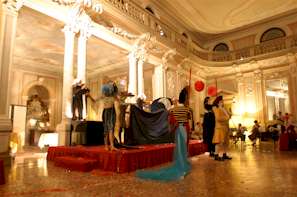
Palazzo Dandolo has been a place of encounters since the early 1600s when it was the first hall to offer gaming rooms (that is gambling). It was the hunting grounds for many a noble including the infamous Giacomo Casanova who considered the Palazzo Dandolo as his favorite backdrop for amorous endeavors. This building is a work of art in every angle. The main hall is a 3 story atrium with a balcony, walkway around the upper floor, and numerous sitting rooms. The center area covered by an elliptical domed ceiling with plaster decorations. Around the center open area, supporting the walkway and balconies, numerous white marble columns, separating the center area from the surrounding spacious, but more private, sitting areas on the ground floors. The walls are covered with unique murals and each area has arched statue areas protecting various sculptures.

A string orchestra is positioned in one of the sitting areas and is playing Strauss as we arrive. At the opposite side of the central area a stage is set where actors are preparing for the theatrical presentation scheduled immediately after dinner.

A smorgasbord of dried meats, fish pate’ and spumante start the evening. The tables are colorful. Each table seats 12 nobles in costume. An opportunity to chat preludes the feast that has been carefully prepared. A traditional soup made with various vegetables begins the gluttonous event. Behind their masks, the unrecognized flirt, chat, and generally engage in provocative discourse.

The main course is beef and pork. This derives from the Serenissima Republic when Ulrico, an ally of Pope Adriano IV, took advantage of the war between Venice and Padova to assist the rebellion of 12 feudal lords attacking Grado. Grado fell and forced the Patriarch, Enrico Dandolo, to flee. The response of Venice was swift. Venice sent her powerful float to Grado and humiliated the Ulrico’s forces and brought the 12 feudal leaders and Ulrico to Venice to be judged. Their lives were saved through intervention of the Pope however Venice demanded, and received, homage from the Pope of 1 bull and 12 fattened pigs every year on Fat Thursday. The pigs, representing the 12 feudal leaders, and the bull, representing Ulrico, were then decapitated by a single swoop of the blade and the meat distributed to the people of Venice. This gave origin to a popular saying in Italy, “Tagliare la testa al Toro”, which means to eliminate a problem with one dominating action.

Sausage, cotechino, braciole, roasts, stews fill the tables. Red wines from Collio and Veneto abound, including my favorite Refosco. Mixing and mingling, switching tables, joining old friends and making new ones continues. Mischievous phrases and sensual attitudes are encouraged by the guise of anonymity and the party moves on. As the cheeses and fruit arrive the orchestra is playing the Waltzes.

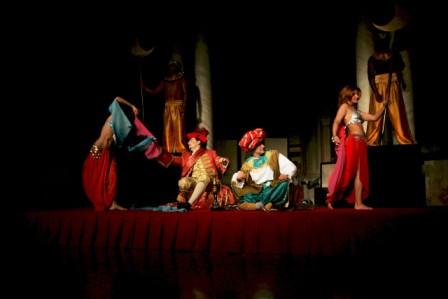
Comfortable chairs have been situated in the center hall facing the stage where the story of “Casanova in Istanbul” will be played. An interpretation of due respect with historical references and the occasional Venetian dialect is enacted before us. This is a story of cunning, intelligence, beautiful women, romance and an offended party. This has all the basics of a box office hit, “Sex, Violence, and Romance”. An outrageous applause completes this segment. We move to taste the desserts, something very difficult by this time as both of us are wearing a 1500 girdle, and refill the wine.

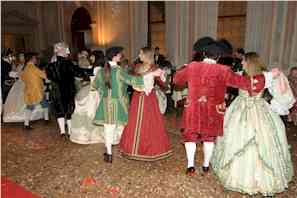
Raffaella is arduously engaged in conversation with duke of something or other. He is attempting to get her to remove her porcelain mask. This would be a great conquest as it would show that she is comfortable with him. The Waltz plays again. I excuse myself with the insistent admirer and Waltz my Dama to the central floor. The chairs have been cleared, the music is playing and nobles, duchesse and princes are gleefully prancing across the room. Colors streak and blur and the Waltz continues, flowing gowns seem to be streams gurgling, mighty dukes hold their heads high and arch their backs while they support their companions who glide sinuously around the room.

Time has passed, numerous interruptions due to a gentlemen’s or ladies insistence to dance have kept us to early in the morning. Soon the sun will rise on another marvelous day in Venice but for us it is time to begin Lent. Sleeping for the next twelve hours should be a good start.

Tags:

Labels: , , ,

Read the Full Story...

Monday, February 13, 2006

Carnevale di Venezia – Carnival in Venice Part I

When we think of Carnival, we think of Rio with its parades and beautiful dancers or Marti Gras in New Orleans with its festivities however Carnival in Italy has deep roots and traditions. In fact it is a Catholic holiday marking the beginning of Lent. It is a final moment of celebration where just about anything permitted before 40 days of contrition. When the Catholics immigrated to various parts of the world they brought their traditions with them.

All of Italy celebrates Carnival and not in the ways you may think. This is an antique celebration, full of tradition, beautiful women and folkloristic customs. Venice is by far my favorite of all of the locations.

I called for breakfast in the room. Raffaella enjoys sleeping in, but as soon as she awakes wants to have breakfast. A cup of hot water with half a lemon, two carafes of espresso, hot milk and some sweets.

It is chilly, probably seventy degrees in the room but the humidity from the sea penetrates your bones. The bathrobes are inviting, draped over the heating elements, they are toasty warm.

As I start sipping my coffee, it takes 2 or 3 doubles before I get going, the bells from one of the local churches start ringing. Most of Italy has installed the electronic bells system but these are the real thing. Deep, clear tones, cadenced intermittently by joyous high notes permeate the walls. Raffaella slumbers into the parlor through the double doors that separate the bedroom and cuddles me a bit on the Victorian couch before settling down in the heavy upholstered for breakfast.

As we stroll into Piazza San Marco the song “Baby, it’s cold outside” repeats over and over again in my head. A double-breasted suit, heavy wool overcoat and scarf are not enough to compensate for the humidity that penetrates deep in your bones. As the sun rises the temperature is becoming more bearable. The only thing I can think of is getting something to warm my bones. We find a café and order a China Caldo, liquor made from artichokes and steamed with an espresso machine.

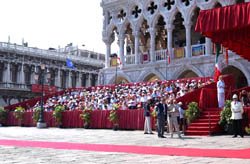
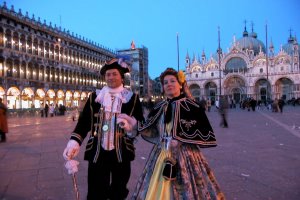
Piazza San Marco is brimming with movement and colors. Carnival, almost eliminated in the period from 1774 to 1970 by a law prohibiting the use of masks, has become again a festive occasion and Piazza San Marco is the center of the activities. Children, of all ages, are out in full force. Elaborate costumes from the Serenissima are predominant. The numerous quarters of Venice participate with standards, gondolas, and theatrical skits. Women in luxurious velvet gowns, hats and masks scurry in and around the columns of Palazzo Ducale while the dignitaries, dressed in medieval garb are accommodated under the Campanile di San Marco. Were it not for the metal chairs and tables at the café it would be difficult to determine that we were actually in the twenty-first century.

I can see a hot platter of Chiacchere or Crostoli as they are called in Venice. Fried pastry pasta covered in powdered sugar. The sweets are made only during Carnival and are incredible. I would not eat them all year long but once a year is a tradition worth renewing. No lunch today, we are attending a dinner dancing party to celebrate the end of Carnival and there will be enough food for 10 days so a plate of Chiacchere is perfect with a hot chocolate. The hot chocolate is rich and dense. Made from Cocoa and milk, heated with the steam compressor from the espresso machine this is like drinking molten dark chocolate. As I sip on this chocolate delight I can feel my face flush and am warmed from the insight almost to a sweat.

The parade of the costumes has begun. Vibrant colors, heavy cotton woven bell gowns, brilliant silk patterns, white powdered faces, exuberant wigs and elaborate masks evidence the great wealth and power of the Serenissima regime. Men in tights, heavy velvet jackets, silk fluffed shirts with white wigs compliment the voluptuous women that represent this time. The explosion of colors overcomes the senses as the grand finale in a fourth of July fireworks display. Thousands of Veneziani represent the various periods and quarters of Venice.

The coronation of the parade is celebrated by the “Flight of the Doves”. Originally this was the “Flight of the Turk”. Tradition indicates that in the late 1500s, Turkish acrobats were brought in to perform during the month of Carnival. A young Turk, to accentuate the dominance of his family, walked a rope from the ground to the top of the tower of San Marco and back again. Today the flying acrobats are dressed as angels and doves and perform the same feat. Breathtaking is the speed with which they glide over the ropes and above the crowd.

As the sun begins to set, the air cools. It would be time to return to the hotel to prepare for our evening activities, but the day brought one emotion after another, with visions of long past times and futures yet to be discovered. I take Raffaella by the hand and quickly head toward the small port, more like a series of small piers, at the entrance to the Piazza. A tour of the city in the gondola is just what we need. An elderly gentleman, his face ravished by the elements but gentile, stands in his traditional attire at the rear of his sky-blue and white boat. He pulls out a heavy wool blanket as we huddle together just in front of him.
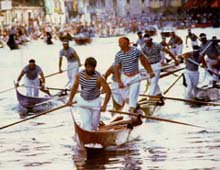
We remain silent, passing the many suggestive scenes in the canals of Venice. The boat slides through the water silently. The water lapping against the sides of the boat are the only sounds as the gondoliere propels the gondola through the canals with the gondolier’s long poll. Ponte Sospiri, Ponte Rialto, and other points of interest that have been heralded through the years in literature and paintings appear before us and quietly slip away. Livio, our gondoliere, has been doing this for 40 years, his father had been a gondoliere as his grandfather. He spoke with pride, and a bit of sadness, as he explained that his sons had gone to University, one was a lawyer and the other a doctor. As we approached various landings along the canals he would tell us about the family that owned that building or some other story about how that particular place had been important in history. Too quickly our tour was over. Livio had brought us directly to the hotel and while we wished him farewell, much to our surprise, he hugged us and exchanged the traditional Italian kisses on the cheek.

The hotel is warm and bustling with people dressed in costume. Before changing our dress, before dinner drinks are customary. The hotel’s bar is a celestial haven. The ceiling is a stained glass depiction of past times, crystal chandeliers with hand blown Murano glass stems in the shapes of Tulips and other flowers. Walls usually finished in dark wood or marble are depictions in stained glass of the Serenissima period. Raffaella orders a Prosecco while I request a Johnny Walker Blue with a glass of cold water. This environment is lively and relaxing. Huge armed chairs with antique parlor tables adorn the room. We discuss the days activities and although we spend most of our time together it seems that we never run out of things to say.

A beautiful day but the evening holds a whole new Carnival di Venezia. Continua…

Tags:

Labels: , , ,

Read the Full Story...