Monday, August 28, 2006

Chocolate Mousse – Exponential Decadence Realized

Chocolate Mousse is one of the purest forms of luxurious decadence. The intense dark chocolate color oozes upward out of the cup. The velvety cream folds onto itself, defying gravity. Smooth rounded ridges climb the mountain of delight to the curly peak. Shaved dark chocolate and a dollop of whipped cream are clouds of early fall before the snow falls.

I love chocolate. I love great chocolate, no milk chocolate with sugars or the too sweet white chocolates but the simple, very intense, cacao butter chocolate. My good friend from Porto di Ripetta in Rome introduced me to the basics of this chocolate mousse knowing my passion for truly intense chocolate expressions. He perfected the signature recipe for his family restaurant in Rome and I have modified it for my personal obsession with chocolate. For the milk chocolate people a spoonful will be more than enough. For the chocoholics a 4 oz. portion should suffice but for the truly insane chocolate lovers the full 6 oz. portion will satisfy, as no other fix, your needs.

If chocolate is aphrodisiac, a full 6 oz. portion of this sinful mousse will release the deepest and most basic passion in your partner. Dose it well.
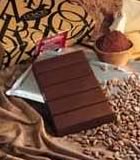
Ingredients for 8 servings:

12 oz. (325 g) Dark unsweetened chocolate 65-85% butter cacao (bar form) cut into small pieces
(The Porto di Ripetta version uses 8 oz (220 g) dark chocolate)
½ cup (110ml) Milk
2 cups (440 ml) Heavy whipping cream
4 egg yolks
¼ cup sugar
1/3 (75 ml) cup coffee
Chocolate shavings or whipped cream

Preparation:

You will need a double boiler and two pots for the preparation of this dessert.

Whip the heavy cream to soft peaks. Cover with plastic wrap and place in the refrigerator.
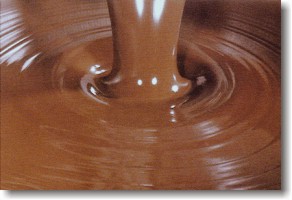
Bring the double boiler water to a boil. Place the egg yolks in the pot and whisk in the sugar. Continue whisking over the boiling water for about 3 minutes until the yolks start to thicken. Continue whisking while the yolks cool, about 5 minutes. The yolks will take on a creamy texture with white streaks on top. Set aside.

Remove the whipped cream from the refrigerator.
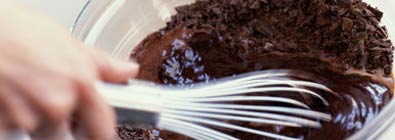
Place the chocolate bits, coffee and the milk in the second double boiler pot. Turn the heat off once the water boils, mix the chocolate and milk. Turn the heat off. Whisk until the chocolate completely melts. Do not overheat. Remove from the hot water and whisk the chocolate into the egg-sugar mixture.

With a spatula or wooden spoon, fold in the whipped cream. Remember when folding egg whites or whipped cream, always use a bottom to top motion. Never use circular or downward strokes.

Pour into parfait glasses, small bowls or cups. I use porcelain tea cups which hold their temperature very well and give the guest something to hold onto without putting their hands onto the dessert container (this would warm the semi-freddo).

Cover with plastic wrap and refrigerate at least 1 hour before serving. When serving remove from the refrigerator at least ½ hour before presentation. Add whipped cream, chocolate shavings or both just before presenting this gift to your guest.
I would serve this with a structured red wine. Bricco Asili Barbaresco, Chianti Classico Castello Monastero, Romitorio Di Santedame 2000, and Capezzana Ghiaie della Furba 2000 are all marvelous choices.


Cakes Available online


Tags:

Labels: , , ,

Read the Full Story...

Monday, January 09, 2006

Turin means Chocolate

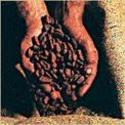
When we think of quality chocolate often we think of Swiss or Dutch versions however Italy has a strong tradition in the production of chocolate and Turin was the birthplace of Italian chocolate production. Since I am a chocoholic each trip to Turin meant a chocolate fix. I would always try some new place and the number of family owned businesses that have perfected the art of making chocolate is impressive. I know I have not convinced you that chocolate and Turin are synonyms so I thought the history of European chocolate would be interesting.


The folklore of Chocolate: The chocolate plant is said to have divine origins. A princess was left to guard the treasure of her husband. During a fierce battle with the enemies she was overcome. The attacking forces attempted to force her to reveal the location of the treasure but she was killed without disclosing the information. From her blood, the chocolate plant was born. This plant held a treasure in its seeds, "bitter as the pain of love, strong as virtue, slightly red as blood".

Chocolate was also the coinage of the Aztecs. A pumpkin cost 4 beans, a rabbit 10 beans, an amorous night with a concubine 12 beans, and a slave 100 beans.

From France, the chocolate bean was introduced into Piemonte in the late 1600s. Numerous pastry chefs began working the new material and Turin quickly became the capital for chocolate. The first regal license and process patent, from the house of the Savoia, was granted in 1678 to Gio' Battista Ari. Shortly thereafter the first chocolate production plant opened. Soon after the monks from various monasteries found that this was a good way to increment their natural food product lines and moved heavily into refining and producing chocolate. In the middle 1700s various Swiss chefs worked as apprentices in the Turin chocolate facilities. You can still see the influence of the Turin chocolate makers in Swiss production by the names utilized for their top line chocolates.

Initially chocolate was only available as a drink. The process to prepare chocolate was very similar to that of coffee.

In 1732 a French artisan Dubuisson invented the flat table heated with hot coals. This process was significantly more efficient because it allowed the workers refining the chocolate beans to stand up. From this invention, in 1778 in France, the first hydraulic machine to refine the chocolate was patented.

In the early 1800s the English patented a steam based refining machine and began working extremely high quantities of cacao beans.

Later, in Holland, Van Houten invented a machine that extracted the butter of cacao from the beans. This resulted in a chocolate that was more fluid, thus more palatable.

In the late 1800s the Swiss, Daniel Peter, added condensed milk to the chocolate butter resulting in a solid milk chocolate. Simultaneously another Swiss, Rudolph Lindt, created a new and original method to refine chocolate resulting in an extremely refined cacao butter, thus dark chocolate.

Today "Chocolato Caldo" or hot chocolate is still prepared in way very similar to the method used in the 1700s. "Chocolato Caldo" is very hot and thick, much like drinking hot chocolate pudding without all the sugar. This is a marvelous treat in the winter, when in Turin.

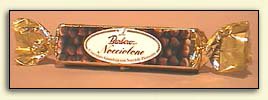
A slight variation on chocolate is the heavenly smooth Gianduia. This chocolate delight has origins of its own. In 1806 Napoleon placed a blockade against the royal family of Turin. The people of Turin would not give up their chocolate but times were difficult. The chocolate chefs came up with a solution. They added 20-40 grams of hazelnut cream for every 100 grams of chocolate. My brother loves Gianduia, he often asks for me to bring these chocolates home when I return from Italy. It should be remembered that high quality chocolates and Gianduia are produced and sold only in the months where the outside temperature is less than 78 degrees.

The places to find really great chocolate in Turin:

Leinì
Giordano
p.zza Carlo Felice, 69 / tel. 011 547 121

Accornero
via Vanchiglia, 32 / tel. 0118 122 859

Gertosio & Sperandri
via Lagrange, 34 / tel. 0115 621 942

Madama Reale
via Mazzini, 19 / tel. 0118 174 385

Peyrano-Pfatish
c.so Vittorio Emanuele, 76 / tel. 011 538 765

Baratti & Milano
p.zza Castello, 27 / tel. 0115 613 060

Stratta
p.zza San Carlo, 191 / tel. 011 547 920


Tags:

Labels: , , ,

Read the Full Story...

Thursday, January 05, 2006

Turin Overview

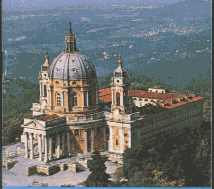
Turin is nestled at the base of the Alps in the northwestern corner of Italy. During my first year in Italy, 1980, I lived for about six months in this beautiful city. I must specify, at that time I was a missionary for my church, so I was very poor. The living conditions were pretty terrible but the apartment, a 5th floor loft with no heating, was located right on the river on the east side of the city in Corso Casale. The stone floors would create dust, no matter how often you cleaned them, and Turin can be VERY cold.

FIAT, the car manufacturer or as they say in New York “Fix It Again Tony”, was still a big company at that time. They were the major employer and 50% of the city’s territory and 90% of the businesses, directly or indirectly, worked for FIAT. The FIAT plants are just huge warehouse like structures, really ugly, and go on for several city blocks.

I lived through this experience and over the years have learned to appreciate Turin for its great culture. In the 1800s Turin was the capital of Italy. One of the 3 primary Italian royal families also called Turin home. Remember that Italy has had several kingdoms thus the royal families are rather prevalent. If you add in Napoleon, who was born in Corsica that was Italy until he, as emperor of France, annexed the island to France.

Today FIAT is less important, after they milked GM for 5 billion, yes billion, dollars they have just about exited the automobile industry. If GM had asked me I could have saved them a lot of money. Turin, once part of the “Iron Triangle”, is no longer the industrial power it was. Turin is dedicating more attention to tourism and that makes Turin, and the rest of Piedmont, a great place to visit. Although my experience may not be 360 degrees, if you like to Ski, visit castles turned into hotels and resorts, eat and stay at Agriturismo (farms where you can eat what is produced directly on the farm), or like to visit wineries, Turin is a great place to go.

Over the next weeks I will talk about the Olympics and make a round of the various wines produced in this area. A word about the people from Turin, there is a saying “Torinese falso cortese,” or “Torinese is double faced.” Watch your Ps and Qs.

Tags:

Labels: , , , , ,

Read the Full Story...