Sunday, August 19, 2007

Valdostana Fondue – Fonduta Valdostana

This is a simple Fontina cheese sauce. Simple, that is, for those who know how to make it. The basic ingredients are Fontina, butter, egg yolks and milk. The trick is to change the viscosity from a stringy cheese into a smooth and velvety sauce. The origins of the Fontina Fondue are not clear. Some say that Cavour is the father and that Fontina Fondue is from the royal kitchens of Turin or Geneva. Others insist that its birthplace is the Canton Ticino in Switzerland.

The first historical reference is in 1854. Giovanni Vialardi included the Valdostan Fondue in his cookbook, “Trattato di Cucina”. Giovanni Vialardi was the royal chef to king Vittorio Emanuele II and Carlo Alberto. There is a reason why this sauce is an important part of high cuisine. It is considered an “appropriate death” for Truffles and Gnocchi, mainstays of the sophisticated palate.

The consistency and delicate flavors of the Fonduta Valdostana make most Piedmont wines, such as Barolo, Nebbiolo, Barbaresco and Barbera, the perfect accompaniment.

Ingredients for 4 people:

1 lbs (454 g) Fontina
¼ stick (30 g) Butter
4 Egg Yolks
3 cups of milk (actually the amount of milk required will change according to the pan you soak the cheese in. The exact amount is enough milk to completely cover the cheese cubes)
Fresh ground Pepper

Preparation:

Cut the Fontina into cubes. Place the Fontina in a bowl and cover with the milk. The cheese should be completely immersed in the milk. Cover the bowl with a towel and let the cheese-milk combination soak for 5 hours.

In a separate bowl beat the egg yolks. Cut the butter into slices.

Choose a heavy pot with a thick base. The pot should be large enough to hold the milk and cheese mix. Place the cheese-milk mixture in the pot and begin to heat over medium low heat. This is a slow cook do not be in a hurry.

Stir slowly with a whisk always in the same direction. Add the butter. Once the cheese has completely melted, add the egg yolks. Continue stirring until the Fonduta Valdostana becomes creamy. The cheese will first melt. It will then cling together in a mass and finally it will dissolve into the milk sauce. Do not stop stirring and do not be in a hurry.

Remove the Fonduta Valdostana from the cooking pot and pour the sauce into a heated terracotta serving dish.

Tags:


Labels: , , , ,

Read the Full Story...

Saturday, July 14, 2007

Agriturismo Villa la Favorita –Alba – Wine, honey, and Cucina Piemontese

Piedmont is a great fall and winter vacation destination. The Italian Alps just a short drive away, some of the best wines in the world concentrated in a small area, honey farms on most every hill and some of the most refined Italian cuisine with wild game, hearty roasts and sauces, tartufo and cheeses that will knock your socks off. If that were not enough there is an agriturismo, located about one mile from the city center of Alba, that offers all of this in one place. Agriturismo Villa la Favorita is a little known agriturismo on the road to Cherasco.

The primary residence was built in the early 900s and recently restructured to permit guest. The agriturismo is located on 10,000 mt2. Most of the land is planted with fruit trees and grapevines. This is the land of Nebbiolo. Villa la Favorita produces Nebbiolo d’Alba and Grignolino Piemonte. This is a family owned and operated agriturismo. Signora Roberta greets her guests with a wonderful and comforting smile. A quick tour around the kitchen and common areas and it is off to your room, one of only six, with a view of ancient Alba.

The day’s activities start with a luxurious breakfast of fresh fruits, obviously from the farm, warm breads and other local sweets. While you are enjoying your coffee on the lemon grove terrace you can plan a trip to the winery, a daytrip to Barbaresco or Barolo, a day in the vineyards, a visit to the honey production facilities, or rent bikes or scooters to check out Alba. How about a day with Sally? Sally is a truffle dog. Most of the year she is a playful companion but from September to December she will accompany you in search of the best truffles in the world.

Be sure your plans include returning to the Agriturismo by early evening. Villa la Favorita offers cooking classes for groups of 4 to 8 people. The recipes are traditional Piemontese and will be your dinner accompanied by the agriturismo’s wine. If this were not enough you are just a hop, skip and jump away from Barbaresco and Barolo.

Villa la Favorita is a great little place made better by the presence and passion of the owner. It is an opportunity to immerse yourself in the culture of Alba and enjoy the balance of the land, the food, the wine and obviously the new friends you will make.

Tags:


Labels: , , , , ,

Read the Full Story...

Sunday, December 10, 2006

Provolone Valpadana – String cheese from Valpadana

Provolone Valpadana DOP cheese is known throughout the world. There are many imitations and the origins are contested. Throughout Europe and some parts of North America Provolone cheese is used on pizza instead of Mozzarella. While Mozzarella is a fresh cheese, best if consumed within days of production, Provolone is an aged cheese. Before reaching the store it ages for 3 to 12 months and has a considerable shelf life. The method of production erroneously leads many to think that Provolone is a Southern Italian cheese but the truth is far more complex and 1000 years of history play their role.

In 300 BC the Romans arrived in Lombardia. Until that time the great plains of the Valpadana, from Milan to Bologna, were forests. The Romans gave land to the legionnaires, heads of the Roman armies, in Lombardia to compensate for their loyalty and to create a first line of defense from invading armies. The Legionnaires changed the face of the land, clearing sections of the forest for farming. This process of transforming the forests to great farms continued after the fall of the Roman Empire. The ensuing Greco-gothic wars and the invasion of the Lombards reduced the cleared lands to wasteland. In 1100 AD the Pope established monasteries throughout northern Italy. The Monks began an aggressive project to reclaim the lands. The abundant water from the rivers and natural springs in the plains created a flourishing agricultural based economy.

The Monks began raising Dairy Cattle and over the next 200 years the cheeses of the Valpadana became famous throughout the world. The economic expansion created a new breed of entrepreneurs. The businessmen figured out that they could allow farmers to produce the milk while they specialized in just making cheese. By the end of the Renaissance, in the late 1600s, cattle and cheese were the primary economies of the Valpadana. In the 1700s further specialization took place separating the dairy from the cattle. The Dairy would process the milk and the farmers would produce the milk.

By the 1800s the Valpadana was the most efficient region for dairy based products because of the significant production of Raw and Processed milk. Because of the availability of the raw material, milk, cheese makers from all over Italy moved their businesses to the Valpadana, including cheese makers from Campania.

The cheese makers from Campania used a different process to make their cheese. It included pulling the milk paste instead of pressing. The production process is the reason Mozzarella and Provolone are considered string cheeses. When the cheeses melt they hold together creating long strings that become thinner and thinner instead of breaking off in chunks. In the 1800s, the southern Italian cheese artisans were able to convince their employers to knead and pull the cheese instead of using the traditional method. Thus, Provolone was born. It is native to the Valpadana but it ancestors are surely southern Italian.

Do not be fooled, Provolone Valpadana is only produced in the plains from Milan to Udine. There is also a Provolone cheese made in the areas around Naples called the “Provolone del Monaco.” If it comes from anywhere else it is a fake. Even when produced in these regions there is a difference between the industrial crap and true Provolone. Provolone will be in its traditional form. The traditional shapes are large Salami, Pear or Melon, truncated cone (for sizes above 100 lbs) and the wine bottle. Your Deli should have the Pear/Melon shaped Provolone.

There are also two basic types of Provolone: mild and spicy.

The Mild Provolone is considered sweeter and will not age more than 3 months. The Spicy will age at least 3 months and will have a “bit of a bite”. Either version may be smoked, indicated as “Affumicata”.

Provolone is great both as a primary ingredient in Italian recipes and as a standalone meal. Wine is perfect with Provolone and the best combinations would include:

1) Wines that come from the same area as the Provolone. This is because the cow’s milk absorbs the same minerals from the plants it eats as the grapes absorb from the ground.
2) A contrasting wine. For example a spicy wine with a mild Provolone.
3) Young and fruity wines, Novello, Barbera, Valcalepio etc. with mild Provolone. Aged and structured wines, like Amarone, Valpolicella, Refosco, and Barbaresco with aged Provolone.


Tags:

Labels: , ,

Read the Full Story...

Thursday, October 26, 2006

Asiago – When Cheese Becomes a Work of Art

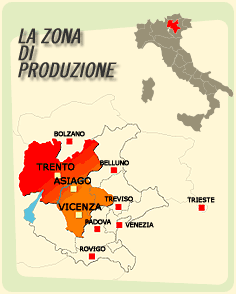
Born in the high planes of Vicenza, Trento and parts of Treviso and Padova, Asiago is an antique cheese that has adapted and modernized over the centuries. During the first millennium AD the fertile planes and valleys of the Vicentino territory were grazed by herds of Sheep. The Sheep were necessary to provide the quality wools for the local industry. True to nature the shepherds were not about to let the milk go to waste. They developed a method to conserve the quality of the milk without the bulk. The resulting cheese was similar to Pecorino prevalent in other areas of the peninsula. Over the next 500 years Asiago was well known as a primary market for its fine wools and unique cheese.

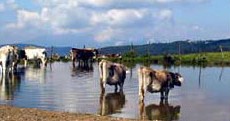
Progress cannot be stopped and by 1500 AD the sheep had given way to cows. The cattle grazed lands that could also provide hay and straw. The dominance of the wool market faded as the Serenissima lost power and cow milk was now used to create Asiago Cheese. Modernization took Asiago cheese to another level over the next 100 years. The cheese makers began pressing the forms allowing the cheese to be aged just 20 days. Asiago was an aged cheese, requiring 4-6 weeks before it could be consumed.

Often my visitors in Italy comment about the different taste of beef in Italy from the United States. In the US just about every piece of beef has the same taste while in Italy it changes from region to region. The primary reason is that the animals consume different grasses, each area has a different mineral make-up as does the water and the air. While this may not seem important to the novice it is a primary differentiating factor not only in cheeses and meats but also in wine. Italy, and now the European Union, protect the geographical denomination of alimentary products. In other words, you cannot make Asiago cheese anywhere, except in the high planes of northern Italy. This protects the quality and the taste. So, if you see Asiago cheese from California or Wisconsin, it may be great cheese but it is not Asiago.


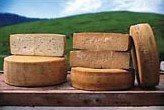
While Asiago comes in two forms, fresh and aged, they are very similar in taste. Both are sweet and encompassing but the aged cheese has a bit of acidity absent in the fresh, or pressed, version. Asiago should never be bitter. The general flavors of yogurt, butter and warm milk are immediately released biting into cheese. The aged version will have a stronger odor than the pressed cheese. The consistency of the fresh is flexible and pliable while the aged version is compact although it should not crumble. The aged cheese will develop tones of walnuts and exotic fruits over the years.

Cheeses in general, and in particular Asiago, should be consumed at room temperature. It is a great compliment to vegetable casseroles and mushroom soups and sauces.

To accompany Asiago I would suggest:

Fresh or Pressed - Valpolicella classico, Vernaccia di San Gimignano, Biferno rosato, Franciacorta spumante brut.

Aged – Valpolicello Rosso, Valcalepio Rosso, Refosco, Franciacorta Rosso, and for a very aged Asiago, Amarone would be a great choice.


Tags:

Labels: , ,

Read the Full Story...

Wednesday, October 11, 2006

Gnocchi alla Bava – Gnocchi with oozing Fontina Cheese

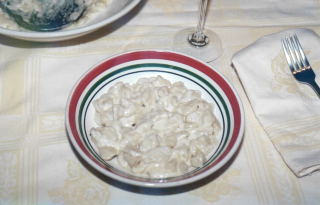
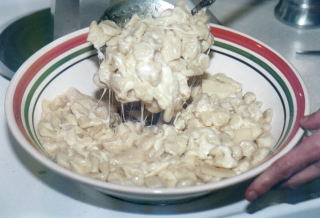
It is not clear exactly where and when Gnocchi alla Bava were born. This recipe is widely noted in regional texts from the Valdostana and northern Piemonte areas. During the Fall and Winter months you will find Gnocchi alla Bava in most taverns and restaurants. This is a cheesy delight, with a bit of a bite from the somewhat tangy Fontina. The cheese slowly melts under the heat of the boiling hot gnocchi just out of the salted water.

The preparation is rather simple and assembling this plate can be done at the last minute allowing you to carry a hot, steaming, gooey plate of Gnocchi and Cheese to the delight of your guests.

Ingredients for 4 people:

Gnocchi
½ lb. (200 g) Fontina
¾ stick (80 g) Butter
Grated Parmesan Cheese
Truffle (optional)

Preparation:

Cut the butter and Fontina in thin slices.

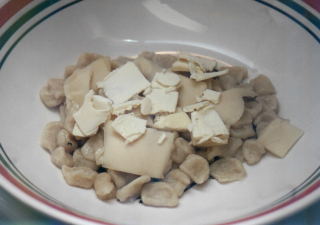
Cook the Gnocchi in abundant boiling, salted water. As the Gnocchi float to the top of the water, remove and drain. Create a layer of Gnocchi in the bottom of the serving dish.

Distribute equal parts of butter and Fontina.

Create another layer of Gnocchi. Distribute evenly additional butter and Fontina.

Continue until all the Gnocchi are in the serving dish.

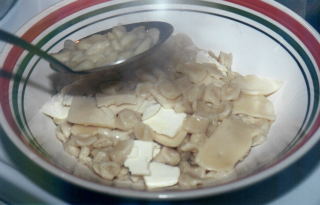
Fold the Gnocchi together lifting from the bottom to the top. Do not use a rotating motion when mixing.

Serve hot with a sprinkle of Parmesan cheese and/or shaved Truffle as desired.

Wine: The perfect wines for this dish are Roero Arneis, Valle d’Aosta Gamay or Grignolino.

Tags:

Labels: , , ,

Read the Full Story...

Friday, September 01, 2006

Fontina – Wonderful Cheese from the Italian Alps

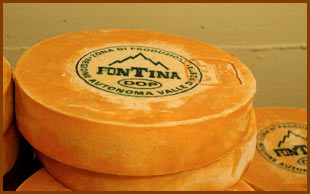
Consorzio Produttori FontinaThank God it’s Fontina. Fontina DOP is a marvelous cheese. A cheese with a bit of a bite that melts when heated creating an oozing semi soft component to a grilled sandwich or when mixed in with polenta. Do not be fooled just because a cheese is called Fontina. Look for the trademark. In all of Europe by law, the name and quality are protected, but the US does not recognize these trademarks so you may find US Fontina in the big box stores. While the knock-offs may be good or even great cheeses they are not Fontina!


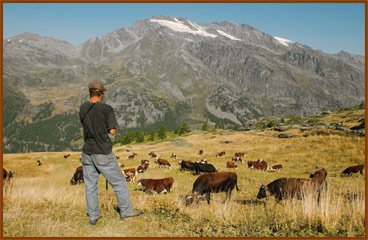
Consorzio Produttori FontinaFontina is produced exclusively in the high valleys of the Alps of Valle d’Aosta. Valle d’Aosta is a scenic and uncontaminated region of Northwestern Italy. The pasture fed cattle produce milk rich in vitamins and minerals. The indigenous flowers and grasses result in the distinct flavors of Fontina. The location of the feeding grounds, far away from both cities and agriculture, high in the Alpine valleys means that this cheese is without pesticides, industrial hormones or additives.

Consorzio Produttori FontinaFontina is a genuine product of nature with roots in the 1200s. The traditional production methods are still employed today. This tasty treat is the realization of what organic products strive to be. The crust is thin and compact while the center is tender and will melt in your mouth. A sweet cheese with a slightly acid hint makes this cheese a perfect ingredient for fondue, gnocchi alla bava, grilled sandwiches, polenta, and as a standalone after-dinner cheese with a medium bodied red wine.


Fontina is a healthy cheese:

Consorzio Produttori FontinaFats: 28% of which (47% d.s.) include 30% unsaturated fatty acids and 58% saturated fatty acids a preponderance of short- and medium-chain fatty acids (more or less equivalent to 14 atoms of Carbon), with low fusion point, therefore not responsible for the cholesterol. Palmitic acid (C 16), considered the principle responsible factor for the cholesterol, determines a cholesterol value in the Fontina equivalent to 80 mg/100g - not high, similar in fact to those levels found in lean meat and less than in eggs. In addition its quantity diminishes in the Fontina of the high pastures because of the different food the cows ingest.

Eating healthy means choosing healthy foods. It does not mean eliminating everything that is good to eat. Choose well, eat healthy and enjoy!

You can find additional information about Fontina from the two organizations which protect both the methods of production and its quality. They are:

Consorzio Produttori Fontina
Cooperativa Produttori Latte e Fontina

Tags:

Labels: , ,

Read the Full Story...

Tuesday, August 01, 2006

Cheesecake – Italian - Greek - American?

Cheesecake, as known in the US, is a rather new creation however, the first mentions of Cheesecake seem to be from Ancient Rome. The first recipe, written in Latin, is from Cato and is called Savillum (Giacosa, Ilaria Gozzini, "A Taste of Ancient Rome", University of Chicago Press, Chicago. 1992, p. 163) and was made with Farmer’s Cheese better known as Ricotta. Other sources indicate that a crumbled cheesecake was served, in 876 BC, to the Olympians in Ancient Greece. Cakes made with cheese are still widely used in Italian cooking. One of the most famous is the Torta di Ricotta but these cakes have little to do with the version of Cheesecake known today. Cheesecake then appeared in France and England in the 15th and 16th centuries.

Cream cheese, the basic ingredient for the common cheesecake, was invented in the US in 1872. The American dairymen were trying to recreate the French cheese Neufchâtel, a very close cousin to the Italian Mascarpone.

Our taste in desserts is considerable less sweet than most Americans. The Cheesecake, with a few modifications, perfectly meets our idea of what a breakfast sweet or dessert should be. I have been working on this recipe for over five years and only recently have found the flavor and texture desired. My first objective was to decrease the sweetness supplied by sugar allowing the natural flavors to be exposed. The second objective was to eliminate the pasty sensation that coats your mouth when eating cheesecake preferring a smoother, silkier, and more balanced texture that is common with Mascarpone. Finally the cake had to have tremendous flavor without adding syrups or sauces. I wanted to accentuate the balance of the acidity and sweetness of the cheese.

Finally, it was a primary goal to eliminate the industrial fats and sugars in the graham cracker cookie base. During my research I found that until the 1970s the cheesecake base was actually shortbread, which is a very simple butter, sugar, and flour cookie.

Both proportions and methodology are extremely important to arrive at the end product. You may also prepare any simple syrup with fruit to top the cheesecake once cooked if you want to add sweetness.

Ingredients for a 10” cheesecake

For the Crust

1 cup all-purpose flour
½ cup softened butter
¼ cup sugar
1 egg yolk
¼ tsp. Vanilla
1 tbsp grated lemon peel

For the Filling

32 oz. cream cheese
¼ cup heavy cream
1 cup sugar
¼ cup flour
¼ tsp. Vanilla
1 tbsp. Grated Lemon peel
¼ tsp. salt
5 eggs
2 egg yolks

Preparation:

For the cookie crust – mix the flour and sugar together. Mix the egg yolk, the vanilla and the lemon peel together. Add the butter to the flour and stir in with a fork. Add the egg yolk mixture, stir with the fork, mold into a ball with your hands and cover with plastic wrap. Refrigerate for ½ hour.

Preheat the oven to 400 degrees.

Butter the bottom of a spring-form 10” pan and cover with parchment paper or wax paper.

Roll the cookie dough and place in the pan. Spread evenly over the bottom of the pan.

With a fork, poke holes in the cookie to allow steam to escape during baking. Place in the oven and bake for 10-12 minutes until golden brown. Do not over cook. Place on a rack to cool.

For the Filling:

Cut the cream cheese in cubes with a knife. Add the heavy cream and mix quickly with a fork just to further reduce the size of the cream cubes. Mix on low speed with a paddle. Scrape down the paddle and the edges of the bowl and slowly increase the speed of the mixer until the cream is smooth and fluffy.

Mix the flour, salt and sugar together in a separate bowl.

Scrape down the sides and paddle again. While mixing at low speed slowly add the flour-sugar mixture. Scrape down the sides and paddle. Increase the speed to medium.

Add the vanilla, lemon peel and yolks. Scrape down the sides and paddle. One at a time, add the remaining eggs. Wait between each egg until the previous egg is completely incorporated.

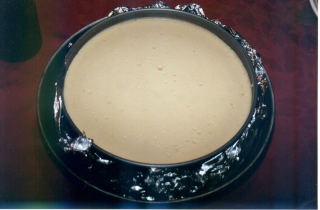
Place aluminum foil around the bottom and sides of the spring-form pan and position the entire pan in a larger pan. Pour the filling into the spring-form and let sit for 10 minutes to release the air bubbles in the mixture.


Heat the oven to 420 degrees. Pour hot water into the larger bottom pan containing the spring-form pan. The aluminum foil will keep the water from arriving at the spring-from pan but still moderate the heat absorption that is the primary cause of splits in the cheesecake.

Bake for 10 minutes. Turn the heat down to 250 degrees and bake for an additional 60 minutes. Before removing the cheesecake from the oven, gently shake the pan. The external ¼ ring of the cake should be firm while the interior ¾ giggles just a bit.

Set on a rack to cool. The filling will completely firm while cooling. If moving to a separate serving plate, wait for the cake to cool completely before attempting to slide onto the plate. Refrigerate overnight before serving.


A great wine would be a Modus Ruffino 2000.


Tags:

Labels: , , ,

Read the Full Story...

Thursday, June 15, 2006

Mozzarella di Bufala – Fact and Fiction

Mozzarella can be found in many forms but rarely tastes the same as the Mozzarella found in Italy. There are many reasons. The first is that Mozzarella di Bufala is made from the milk of the Water Buffalo. Another reason is that Mozzarella is a fresh cheese, which means it should be consumed within days of production. Another point in case is that Mozzarella must remain in the serum until it is consumed. All of these basic requirements make Mozzarella an unlikely candidate for mass production and distribution.
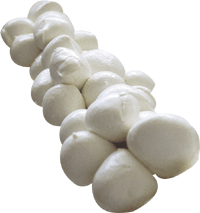
This does not mean that the products named Mozzarella are not good cheeses, simply that they are not Mozzarella. In Italy, where false advertising is a felony and the naming of products is controlled by legislation, the products that do not meet the basic requirements are called string cheese, mozzari, or by some other similar imaginative name.
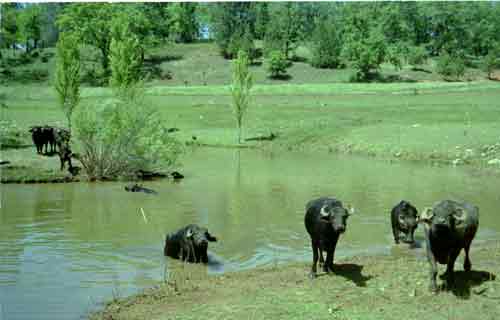
Mozzarella di Bufala has antique origins. First found in official documentation in 1570. The word Mozzarella derives from the base word Mozzare or to cut off by pinching between the index finger and the thumb. This term comes from the process of production. Once the cheese ball has formed the artisan pinches a small amount of cheese from the ball, thus Mozzarella.

The Buffalo were originally used for heavy farm work much like the Ox in US history. The farmers believed it was a waste to not use the Buffalo milk but Buffalo milk is very hard to digest. The production process of Mozzarella was designed to tone down the strong flavor of Buffalo milk. The resulting process makes Mozzarella type cheeses made from cow’s milk practically tasteless. The serum is a mixture of the residual whey and brine. The Mozzarella ball absorbs some salt from the brine stopping the fermentation and allowing the product to remain fresh for several days.


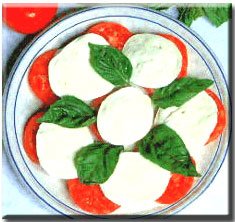
Mozzarella di Bufala is an important ingredient in many recipes but for Caprese and Pizza it is a basic element. When Mozzarella is a basic ingredient it is important to use the real stuff but that can be difficult in the US. We have found one producer who makes real Mozzarella di Bufala and this product can be found, here in Dallas, at Central Market. It will cost twice as much as the industrial string cheese but is well worth the price. The product may also be ordered online directly from the producer Bubalis Bubalis, Inc.

Tags:


Labels: , , , , ,

Read the Full Story...