Thursday, September 20, 2007

SCIACCHETRA' – A rare and unique white wine

Do not look for this wine on the US or international markets. Sciacchetra’ by Der Vin Bun is exclusive and rare. The latest vintage released only produced about 140 bottles. The number is correct, 140 0.75 liter bottles. The waiting list for this wine is just over 2 years. Sciacchetra’ is not a new comer. The same family has produced Sciacchetra’, in the same way, for over 150 years. Over the years, nobility and the famous alike have sung praises to this hidden jewel of the Cinque Terre in Liguria.


“The grapes are of antique gold, flavoured by the cool sea breeze and dried by the sun’s warm kiss.” The vineyards cling to the cliffs of Liguria overlooking the Mediterranean Sea. Production starts only after a group of elderly Sensata go into the vineyard to taste the drying grapes. The Sensata are local wine experts, a title usually passed from father to son. Only after their blessing can this unique wine be made. Very few bottles ever make it out of the Cinque Terre but there is a way to taste this wine and perhaps negotiate a bottle.

The Der Vin Bun also rents out a small apartment which is little more than a hotel room at 380 square feet. A restaurant, also tied to the vineyard is located underneath. A visit to the Agriturismo di Volastra could result in a bottle of this heirloom wine of the Cinque Terre.

Schiacchetra’ is a slightly sweet white wine. The color is that of antique gold with amber highlights. It is made with the autochthon grape Bosco (70%), Vermentino (20%) and Albarola (10%). Figs, candied oranges and apricots dominate its perfume. On the palate it tends to be slightly sweet with salty undertones as the wine sits in the mouth. The flavour of Schiacchetra’ is surprisingly persistent for a white wine.

I would drink this wine with savoury cheeses (creamy gorgonzola), white pasta and gnocchi dishes, baked or grilled fish and many pesto based dishes.

Grape: Bosco (70%), Vermentino (20%) and Albarola (10%).

Color: Antique gold with amber highlights.

Bouquet: Figs, candied oranges and apricots.

Flavor: Complex with a tendency toward sweet with underlying salty tones.

Alcohol: 14.0%

Serving Temperature: 11-13 c.

Glass: White wine glass.

Tags:

Labels: , ,

Read the Full Story...

Tuesday, June 19, 2007

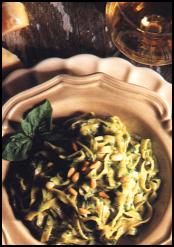
Pasta with Shrimp in a wine sauce and Pesto

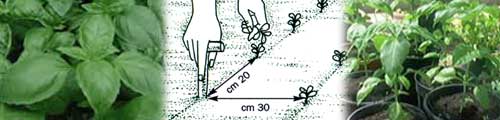
The summer is in full swing and the garden grows. Traditional recipes are best in season. The herbs and vegetables are full of flavor. A traditional recipe prepared in season with homegrown products is without comparison. Our basil plants are doing incredibly well. They are about 15 cm high and the leaves are huge but supple. This has made me think back to my days in Chiavari, on the Costa Azzura. Liguria is patria of pesto. Pesto is used to compliment or accentuate numerous dishes.

Raffaella loves seafood. She has been talking about a good fish dinner for some time. Since I am doing most of the cooking these days and fish is not one of my passions, I have always found a different solution. I learned long ago that a woman satisfied makes for a happy relationship. I delved into the archives of my mind to find something with fish and pesto. Recently we had prepared a reduced wine sauce with Mussels. Thus a perfect solution came to mind, Shrimp in a wine sauce with pesto. We drank Pinot Grigio with dinner but Vermentino, Verdicchio, Greco di Tufo, Fiano and Falanghina are good choices.

Ingredients:

2 lbs. Raw Peeled Shrimp
3 tbs. Olive Oil
1 clove Garlic
1 cup White Wine
Salt and Pepper

1 cup Pesto Genovese
1 lbs. Long Pasta (Spaghetti, Fettucine, Tagliatelle)

Preparation:

The time to prepare the shrimp in wine sauce should be about the same as boiling the pasta. Bring abundant salted water to a boil. Check the time for the pasta to cook. It will be somewhere between 10 and 13 minutes.

Place a large skillet over high flame. Add the olive oil and garlic to the pan. Salt and pepper the oil. Allow the garlic to sauté on both sides at high temperature.

Add the Shrimp and cook for two minutes stirring often. Reduce the heat to medium. Add the wine and reduce the wine for 10 minutes. This should be the same amount of time required to cook the pasta.

Drain the pasta. Pour the pasta into the pan with the shrimp. Stir together well.

Pour the pasta and shrimp into a large bowl and add the pesto. Stir together well and serve immediately.

Tags:

Labels: , , , ,

Read the Full Story...

Sunday, November 26, 2006

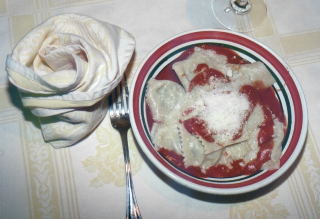
Ravioli Asparagus and Chicken

In many regions of Italy, Christmas traditions include fresh pasta ravioli, tortellini, cappellini, and other nuggets of delicate flavors. While family and friends are together fresh pasta just seems natural. The flavors are delicate, fresh pasta dishes are designed to entice the appetite, get it going, without saturating the stomach or taste buds. This particular recipe is from La Spezia, in the eastern region of Liguria, close to Tuscany and Emilia Romagna.

This is not difficult but it is not a simple throw things together recipe. The result is worth the extra effort particularly for a party or holiday occasion. It is important to use the best ingredients available because it is a delicate recipe. I suggest that you purchase free range chicken if possible. This would also be a great time to break out a Pigato Bianco. Pour a glass, just for you, before beginning preparation.

Ingredients:

For the Chicken

½ lbs. Chicken legs or breast (boneless and skinless)
1 stalk Celery
1 Carrot (cleaned)
1 small Onion (peeled)
1 quart cold water
salt

Preparation of Chicken:

Place the celery, carrot, onion and chicken into a medium pan. Bring to a boil over medium heat. Once the pot boils, reduce the heat to low, and cook for 40 minutes. Remove the meat. Strain the remaining broth and set aside. The Broth will be used for the vellutata.

Ingredients for the filling:

½ lbs boiled Asparagus
¼ lbs boiled Chicken passed through a grinder or finely minced
3 oz. (90 g) Chicken Vellutata
1 Egg and 1 Yolk
1 clove Garlic
3 stems of Italian Parsley (with the leaves attached)
6 leaves fresh Basil minced
1 ½ tbsp (20 g) unsalted Butter
1 ½ tbsp (20 g) Olive Oil
1 ½ tbsp (20 g) grated Parmesan Cheese
Salt, Pepper to taste

Ingredients for the Ravioli and Sauce:

11 oz. (300 g) fresh Pasta in sheets
5 oz. (100 g) Tomato sauce
½ stick butter
5 tbsp (50 g) Parmesan cheese
Salt as needed

Preparation Filling:

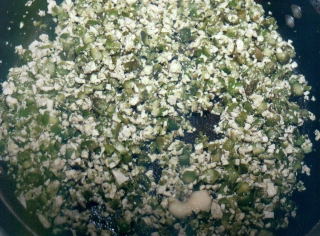
Mince the tips and soft parts of the Asparagus. Mix together with the minced or ground Chicken. In a skillet place the 20 g of Oil, 20 g of Butter, Garlic, Parsley, and minced Basil. Cook over medium heat until the Garlic softens and begins to color. Add the Chicken, Asparagus, and salt and pepper. Cook for another 5 minutes, stirring often.

Remove from heat. Eliminate the Garlic and Parsley. Taste for salt and pepper, adjust as necessary. Move the meat filling into a large bowl. Add the Egg, Yolk, the 20 g of Parmesan cheese and the Chicken Vellutata to the meat mixture and work together with your hands.

Preparation Ravioli:

The pasta should be relatively thin. I use a 5 setting on the pasta roller. Cut the pasta into 1 ½ inch squares. Place a teaspoon of filling in the center of the square. Place another square on top and press from the edge of the filling outward to the edge of the square. This will remove any air. Do not press or spread the filling. If the two sheets of pasta do not seal, brush the edge of the bottom square with water before sealing.

To cook the Ravioli, bring abundant salted water to a boil. Place the Ravioli in the rapidly boiling water and cook for about 5 minutes.

Do not cook the Ravioli until the sauce is ready.

Preparation of the Sauce:

In a medium sauce pan, heat ½ the remaining butter (25 g) and the tomato sauce. Cook for 1 minute just bringing the butter and tomato together.

Bringing it all together:

Place equal amounts of sauce in the bottom of four pasta dishes.

Cook the Pasta for 5 minutes. Strain the Ravioli. Place two tablespoons of the Ravioli water into a skillet over medium heat. Add the remaining 25 g of butter. Add the strained Ravioli and the 5 tbsp (50 g) of Parmesan cheese. Stir together quickly. This will all take about 2 minutes.

Place equal amounts of Ravioli into the pasta dishes on top of the previously prepared sauce. Serve immediately.


Labels: , , , , ,

Read the Full Story...

Tuesday, October 17, 2006

Pigato Bianco 2004 - Colle Dei Bardellini (IM)

Great destinations are the sum of the local experience. It may be the food, the wine, the people, great service, an unusual and unique location, or a feeling of general well-being. Liguria is my favorite place to live in Italy. It is close enough to Milan for work while the climate is beautiful and then there is the sea. The turquoise color water, the cool breeze year round and the small towns built on the cliffs that seem to fall into the sea.

One of the things I do not associate with Liguria, is wine. Liguria is located south of Piemonte and west of Tuscany. You would think that there would be the best of both worlds. I already know that some will immediately talk about Santa Margherita Pinot Grigio. I will not comment on Santa Margherita because I only write about things I like. To the west of Genova there are several vineyards growing the Piemontese Nebbiolo and to the east the Sangiovese from Tuscany. They are ok and with a hearty dish can be appropriate for a table wine, but when I am in Liguria I drink only whites.

It just seems more appropriate to drink white with the cucina Ligure. Whether the meal is Pesto or some great fish based meal, the Heirloom wine from Liguria seems appropriate. Pigato is my choice. Liguria, primarily, produces two whites, Vermentino, which is most often associated with Sardegna, and Pigato. Pigato is not well known and most likely if you see it on the wine list you will not recognize it but this heirloom vine is as unique as it is rare.

The other day was my birthday and Raffaella prepared Ravioli of Asparagus and Chicken in a velvet tomato sauce, an exclusive dish, originally made famous by Angelo Paracucchi and his restaurant in the province of La Spezia, but derived from a local Ligura recipe. We had a couple of bottles of Pigato Bianco 2004 by Colle Dei Bardellini in the cellar, the perfect wine for this traditional dish.

Pigato is a close cousin, perhaps sibling, of the Vermentino grape. It is believed that the vine was introduced into the area surrounding Savona in the 1600s. It is grown only in this limited area and takes its name from the rust colored spots that form on the grape just before harvest. A perfect compliment for numerous dishes including: Mushrooms salads, Stuffed Onions, Crespelle with Mushrooms, Onion Soup, Fresh Pasta or Gnocchi dishes with Pesto, Pasta or Risotto with Mushroom, Shrimp and fish.

Pigato is a dry white wine with a slight acidity but still encompassing leaving an aftertaste of citrus and honeysuckle. While I would not drink this as a standalone it would be a good match for Focaccia Genovese.

Grape: Pigato – Up to 5% can be another white grape as long as it is grown in the same vineyard.

Color: Hay yellow.

Bouquet: Fruity, dominated by apricots and peaches.

Taste: Dry but soft and encompassing. A hint of citrus and peaches followed by a mild but persistent flavor or honey and sage.

Alcohol Content: Minimum 11 %

Serving Temperature: 10-12 c.

Decanting: None.

Pouring: Pour slowly with a 15-20 degree inclination.

Glass: White wine glass.

Aging: Not applicable.

Tags:

Labels: , ,

Read the Full Story...

Tuesday, September 26, 2006

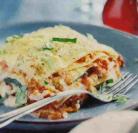
Pesto Lasagna

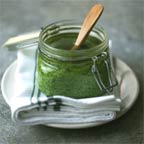
Psto LasagnaWe harvested the last of our basil this weekend. We said goodbye to our evening Bruschetta until next year with a glass of Pinot Grigio and transformed the remaining sweet basil into a quart of pesto. The changing of the seasons is always met with a bit of sadness for the foods we leave behind and anticipation for the new foods about to arrive.

While pesto will maintain its flavor for several weeks in the refrigerator we immediately began a pesto binge. Saturday was spaghetti with pesto and Sunday we made a small tin of Lasagne al Pesto. This is an interesting twist on the traditional baked pasta dish. The pesto screams of summer freshness and flavor. Tomorrow we will prepare several additional tins and freeze them for special occasions this Autumn.

Red Pesto LasagnaWhile this recipe uses only pesto it is equally as interesting with a red pesto sauce, which combines a simple tomato and onion sauce with the pesto.

Ingredients for a 9x12 inch casserole dish (about 1 kg total weight):

400 gr. (14 oz.) Lasagna pasta (we make our own fresh pasta)
250 gr. (1 ½ cups) Pesto
Besciamella
110 gr. (¼ lbs.) Pecorino or Asiago Cheese Chipped or Shaved
40 gr. (1/3 stick) Unsalted Butter

Optional:

1-2 glasses of wine for each individual involved in the preparation, chilled to about 65 degrees. Since this will most likely be the morning I suggest the traditional “Bianchino” from Friuli. This would be a Pinot Grigio. A good wine that you can find easily here would be a Livio Felluga - Pinot Grigio. Another good solution, although not Friulano, would be “Mezzacorona Pinot Grigio from Alto Adige [you can find the 1.5 liter bottle for about 12 $]. I suggest this solution because Mezzacorona started using a composite cork in 2004. Since the wines imported often are not properly stored the wines with a traditional cork risk being contaminated by the cork itself. Throwing away any bottle of wine is a sin so this is a good solution.

Preparation:

Butter the casserole dish on the bottom and sides.

Fill a large pot, a stock pot would be good, with water and add 4 hands of medium or large grain salt (if using regular table salt reduce to 3 handfuls). This is more than traditional pasta water because you will be using the water many times. Bring to a strong boil.

Have a glass of wine.

Cut the butter into pieces and place in the bottom of the casserole dish. Place a couple of tablespoons of pesto sauce in the bottom of the pan. Place 3 pieces of pasta in the hot water and boil for 3 minutes (if you are using commercial dried pasta increase to 7 minutes). Lift the pasta out of the water with tongs and place on a plate. Before adding to the dish dry both sides with a towel. Place the sheet of pasta in the casserole dish, use the other pieces of pasta to create a base of pasta. This is your floor.

Add 2 ladles of Besciamella sauce and spread evenly.

Have some wine.

Get another 3 sheets of pasta and boil, dry and cover the sauce completely. This time spread ½ of the remaining Pesto sauce. Continue for about 5 layers. Continue alternating layers of Pesto sauce and Besciamella until you arrive about ½ inch from the top of the pan. The top should be Besciamella. Do not fill to the top. The lasagna will expand during cooking.

Distribute the Asiago or Pecorino chips across the top.

If you do not intend to cook immediately, cover with aluminum foil and place in the fridge.

About 45 minutes before serving, remove the foil, preheat the oven to 400 degrees and cook for 20 minutes. This will create a crusty top. If you prefer a soft top, use 300 degrees for 35 minutes.

Tags:

Labels: , , ,

Read the Full Story...

Wednesday, May 10, 2006

Pesto Genovese

Comfort foods are man’s capability to bend the environment to meet his needs. Developed from basic ingredients that surround him, he combines, cooks, and marinates until those basic ingredients are flavorful, nutritious and satisfying. This does not happen over night but centuries of ingenuity create truly delightful recipes. Pesto is one of these comfort foods.

Pesto finds its first written confirmation at the time of the rise of the Roman Empire, several thousand years ago. The beautiful but treacherous, and extremely important militarily, Liguria is the birthplace of Pesto. Simple in nature, flavorful yet complimentary, Pesto uses one of the most antique herbs as its primary ingredient, Basil. One prepared Pesto can be stored for several months without refrigeration. The oil eliminates oxidation and bacterial growth. The sweet garlic balances the bright flavors of the Basil and the pine nuts hold the sauce together and give it a bit of structure.

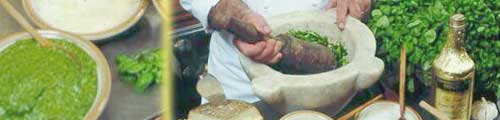
There are many recipes for pesto. In the US, some chefs will add parsley. Do not do this. It is stupid. The only reason they add the parsley is to get the dark green color when their basil is limp and weak in flavor. If pesto is what you want then make pesto, buy quality ingredients, or better yet grow your own. Take the time to prepare the pesto according to the original method. If you use a food processor it will go faster but you will lose both color and flavor. Impossible, you say, actually the nature of the Basil leaf tells the story.

The flavor of Basil is held in the veins. When the veins are cut, the fluid inside is trapped in the veins and does not propagate. Additionally the flavor of basil changes when the oils are heated. The heat rising from the motor of the food processor is sufficient to initiate this change.

Pesto is a great sauce to have on hand all year around. It is a great sauce for pasta and can be used to stuff or spread on bread, and it is a marvelous compliment when rolled in pork or beef roasts.

This is the best recipe I have found, actually Raffaella found this one. It is the one that we have used for many years. It is offered by the Consorzio del Pesto Genovese.

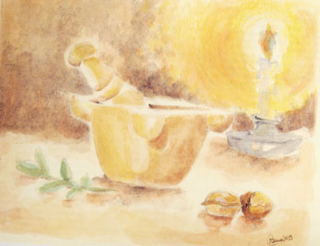
A Marble mortar is necessary for the preparation of this sauce.

Ingredients:

60 leaves of Genovese Basil
1 cup olive oil
3 tablespoons of grated Parmesan cheese
3 tablespoons of grated Pecorino cheese
2 cloves of garlic (peeled and cleaned)
1 tablespoon of pine nuts (pinoli)
¼ teaspoon coarse sea salt

Preparation:

Wash the Basil leaves and dry in a kitchen towel. Be sure the leaves are completely dry before beginning.

Place the garlic and 10 leaves of Basil in the mortar. With a slow, circular motion, crush the garlic and basil into a paste. Do not put too much pressure on the basil. Continue adding the basil, 10 leaves at a time until you have a bright green liquid. This will take some time. Do not rush.

Add the pine nuts and completely reduce them into the liquid. The pine nuts will balance the garlic and give a delicate hint of nuts.

Stir in the Parmesan and Pecorino cheese and the salt. Finally, slowly drip in the olive oil, stirring continuously. Your pesto is ready!

Tags:

Labels: , , , , ,

Read the Full Story...

Thursday, December 01, 2005

Pandolce – Christmas Bread of Genova

There was a time when it would have been considered blasphemy not have time to prepare the Christmas Pandolce, every matriarch guarded her recipe for the preparation jealously. In the times when homes were not heated at night some would take their dough to bed with them to keep it warm so it would leaven properly. This dolce is full of tradition. Today the preparation is only for the most dedicated of home chefs, the others prefer to purchase their Pandolce at the pastry shop but the value of a home prepared pandolce is considered a gift of great value among those from Liguria.

An Olive branch is placed in the top of the cooked loaf as a sign of devotion to God. It was the privilege of the youngest member of the family to remove the Olive branch. Cutting the Pandolce is exclusively reserved for the oldest member of the family.

This Christmas Bread should be prepared about 10 days before Christmas.

Ingredients:
500 grams [3 ½ cups] flour
2 packets dry active yeast
200 grams of sugar
150 grams [1 ½ stick] of butter (room temperature)
100 grams of white raisins (soak for ½ hour in water, drain and dry before using)
100 grams of pinoli
40 grams [½ cup] of candied fruit
50 dl [½ cup] of milk
100 dl [1 cup] water of orange blossom (this can be made with 1 teaspoon of extract and water)
100 dl [1 cup] sweet Marsala

Preparation:

Warm the milk with a little bit of sugar. Dissolve the yeast in the warm milk and let sit for 10 minutes.

In a mixing bowl mix half of the flour with milk-yeast mixture. Cover with plastic wrap and let sit for 1 hour.

In a medium sized bowl mix the sugar, orange blossom water and marsala. Pour the remaining flour on the dough, add the marsala mixture and mix the dough. Work the butter into the dough with your hands or dough paddle. Cover and let rise about 2 hours.

Place the raisins, pinoli and candied fruit pieces into a small bowl. Add 2 tablespoon of flour and mix together. Roll the dough to about 1 inch height and spread half the mix and roll the dough into a log. Roll the dough again to about 1 inch height and spread the remaining mix. Roll into a log again and then form into a ball.

Place in a heavily buttered baking pan, cover with a towel and let rise for at least 3 hours. If your kitchen is less than 75-78 degrees do this at night and let rise overnight.

Before placing the dough in the oven a triangle is cut in the top of the loaf to permit greater volume during the baking process. Preheat the oven to 425 degrees. Bake for 45 minutes. The crust should be rather dark and may require another 10 minutes.

Finally when cutting the first piece of Pandolce all present repeat the salutation to Christmas:

Long life to this bread
A wish of health to all;
Today as tomorrow
Cut this bread and sit with us;
For all to eat in peace
Children, big and small;
With family and friends
In all the years to come
For the grace of God

Health and peace at home and away; Holiday Greetings to all.

Traditionally a family would prepare numerous Pandolce at Christmas and store them in paper in the cantina (cellar). They would last all year long. The first time I had Pandolce I was told that it was their family tradition to not eat the first piece of Pandolce cut but to put it away and give it to the first poor person that knocked on their door (maybe they were trying to tell me something!?!)

Tags:

Labels: , , , , , ,

Read the Full Story...

Monday, October 17, 2005

18 days in Italy – Part 5 of 5 – Cinque Terre

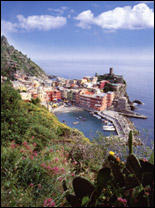
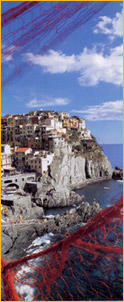
The Cinque Terre, 5 lands, are Monterosso, Vernazza, Corniglia, Manarola, Riomaggiore. Located to the east of Portofino and just to the west of La Spezia, they have been cut off from the world in various occasions. Originally the Etruscans built forts protecting sea access to the Italian Peninsula. After the fall of the empire the road deteriorated for lack of repair. The only way to interact with the outside world was by boat. The Romans repaired the Etruscan roads and the Cinque Terre grew in importance however the Genoa Empire again closed the road cutting off the local inhabitants.

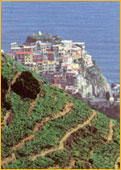
The characteristics of the terrain that made the Cinque Terre great forts was a tremendous hindrance to people’s survival. Mountains that fall off straight into the sea do not easily permit farming. Supplies arriving by sea would have to be carried up the steep mountain slopes and without the road travel by land is nearly impossible. Over the centuries the inhabitants have sculptured the mountains, conquering the treacherous slopes, cultivating their staples in small terraces carved into the mountain. Supplies are brought in and produce brought out with wicker baskets pulled or lowered from terrace to terrace. Things are not much different today. Farm equipment is just too big to work in the terraces.

You can enter the Cinque Terre in 3 ways: by train, by car along winding roads, or by boat. Although the views are incredible I would suggest you lodge in La Spezia and take day trips to the various Cities by train. On one occasion you will also want to take a boat trip to visit San Frutuoso, Chiavari and Portofino, favorite port of the international VIPs. San Frutuoso is a small town built in a ravine and has a little bay. It is famous for its crystal clear waters and an undersea church with a Madonna at about 3 meters under the surface. Chiavari is a great shopping place with great food and in Portofino you can sip coffee in the afternoon at the café on the shoreline while the sailboats and yachts of the rich and/or famous troll by.

The Cinque Terre are famous for Trofie, a rudimentary pasta made from chestnut or wheat flour. Pesto is the sauce of choice however the version from the Cinque Terre does not include garlic. The handmade tagliatelle pasta is a slightly wider version than the original in Emilia Romagna. Fish and mollusks are the primary staples of all local main courses and the vegetables, zucchini, Swiss chard, artichoke and leeks, along with herbs that grow wild on the mountain slopes. A local favorite is stuffed anchovies, anchovies stuffed breaded and fried and “bianchini”, not the kind from Friuli which is a small glass of white wine but baby sardines fried and eaten whole.

The wines of this area are quite unique. The vineyards all face south, toward the sea. They are all terraced into the mountains so when the wind blows or a storm comes up everything exposed to the south is covered in the salty sea mist. The plants, fruits, vegetables, olives, land, people, … everything. The wine of this area exalts that flavor. This area also produces olive oil. The moderate year round temperature and the sea mist produce an olive that is smoother and less acidic making this a great oil to use for salads, bread and just poured straight on fresh tomatoes.

Tags:

Labels: , , ,

Read the Full Story...